A practical guide to job interview preparation: decode the job post, research the employer, build STAR stories, rehearse, prepare your own questions, handle video and in-person logistics, and follow up.
Good job interview preparation is mostly four things: understanding what the job needs, knowing the employer, having a handful of real stories ready, and practicing out loud.
Most interviewers are checking evidence, not charm. MIT's career office describes behavioral interviewing as a way to measure past behavior as a predictor of future results, so your examples carry the interview.
Prepare three to five stories, not thirty scripted answers. MIT's guidance is that one well-built story can be adapted to several different questions.
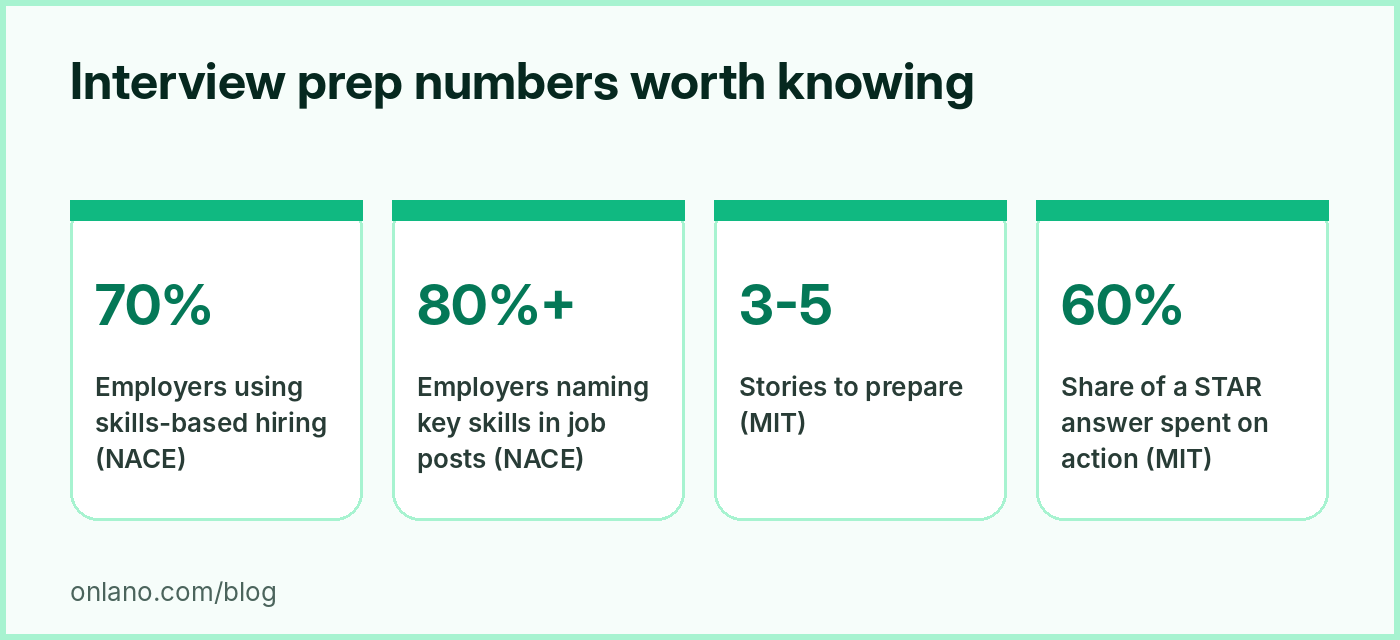
Employers are leaning on skills. According to NACE's Job Outlook 2026 survey, 70% of responding employers report using skills-based hiring, up from 65% the year before.
Sort logistics early: format, time, tech, route, documents, and who you're meeting. Boring problems sink good candidates.
An interview is a structured conversation where the employer decides if you can do the work and you decide if you want it. Preparation is how you make sure the conversation covers your best evidence rather than whatever happens to come to mind under pressure.
Here's the honest version. You can't predict every question. You can predict the topics: why this job, why this company, what you've done that's relevant, how you handle problems, what you'd want to know. Prepare for those, and nearly everything else is a variation.
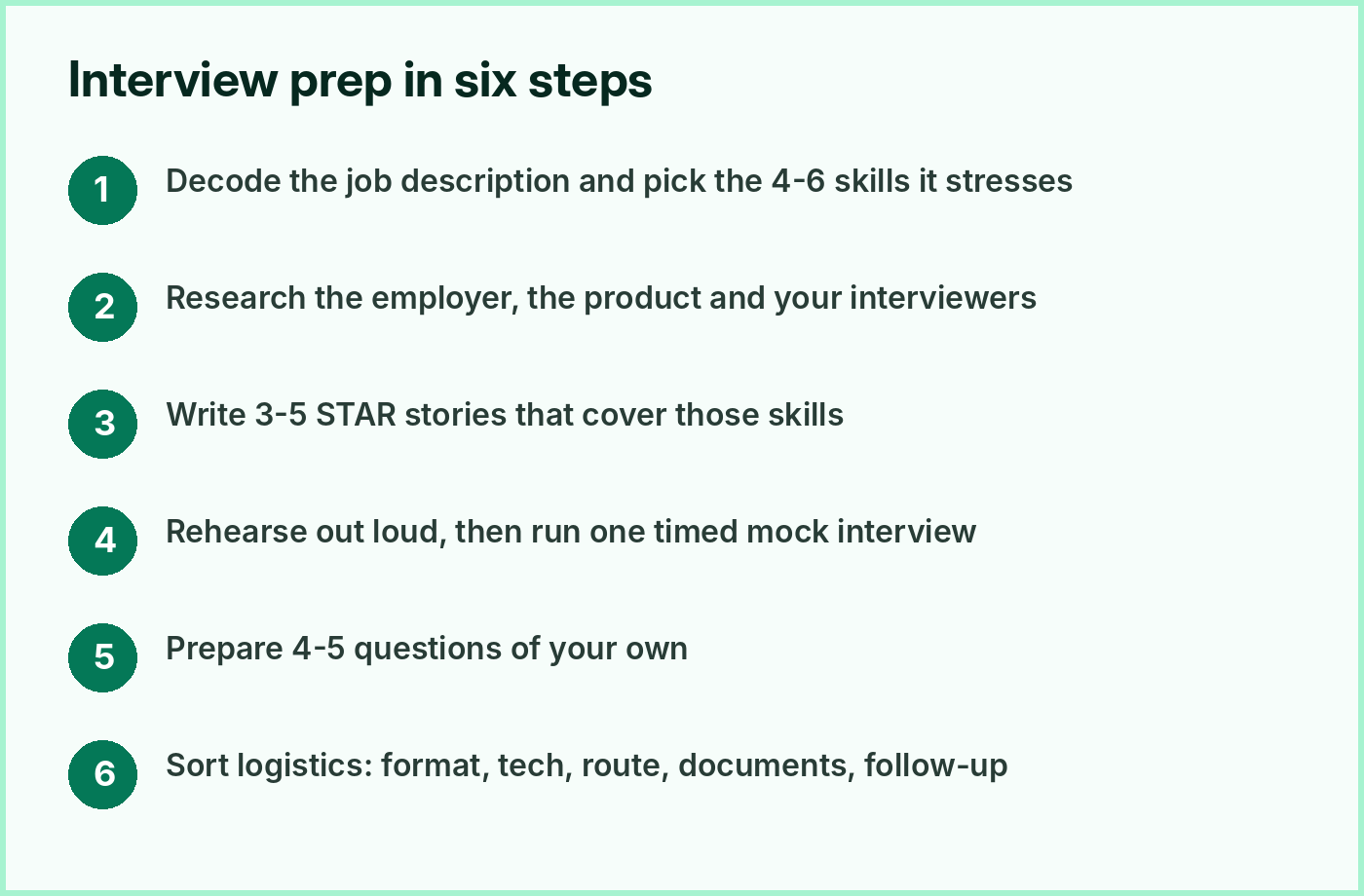
The whole process fits in six steps.
The six-step interview prep routine used in this guide
Give yourself at least two to three evenings for an important interview. For a first phone screen, one focused evening is usually enough. For a final round at a company you really want, take longer than you think you need. The first hour is always the least productive.
Treat the job post as the interviewer's cheat sheet. Most of the questions you'll get come from it.
Print it or paste it into a document. Then:
Highlight every skill, tool and responsibility.
Mark the ones that show up twice or sit near the top. Those are the priorities.
Next to each, write one concrete thing you've done that proves it.
For gaps, write down the nearest thing you have done and how you'd close the rest.
MIT's career office suggests looking at the action verbs and how often particular ones repeat in a posting, because they signal what the role actually involves. NACE reports that more than 80% of employers highlight the key skills needed for a position when they write job descriptions, which means the posting is genuinely telling you what they'll probe.
If a skill is listed and you've never used it, don't hide that. Say what you've done that's closest and how fast you've picked up similar things before. A calm, specific answer about a gap reads better than a bluff that falls apart on the second follow-up.
The research goal isn't to recite the About page back at them. It's to be able to say something specific about why this company and this role.
Spend 45 minutes on this, in this order:
Product or service. Use it if you can. Sign up for the free tier, read the docs, browse the site as a customer would.
Recent news and priorities. Press releases, the careers page, the company blog, an interview with a founder or leader.
The team. Look up your interviewers if you know their names. Stay professional about what you mention; a shared past project is fine, personal details are not.
The role in context. Who does it report to? What problem is the team trying to solve? Reviews and recent job posts for similar roles can hint at the day-to-day.
Write down two or three things you found that genuinely interest you, plus one real concern or question. Those become your closing questions later.
Not sure which employers to chase in the first place? Browsing live roles with filters for category, country, work mode and company on Onlano helps you notice which teams are hiring for the same skills repeatedly, which tells you something about their priorities.
Step 3: Know the kinds of interview you might face#
Prep changes with format. Ask the recruiter what to expect; the UK's National Careers Service advises finding out whether it's in person, by phone or on video, and Canada's Job Bank suggests asking whether there'll be a test and how many people will interview you. Nobody minds the question.
Format
What it usually tests
Prep priority
Phone screen
Basic fit, interest, salary range, availability
Short pitch, motivation, quiet space
Live video interview
Same as in person, plus how you handle tech
Camera, audio, lighting, notes just out of frame
One-way recorded video
Answers to preset prompts, often with a time limit
Practice answering to a camera without feedback
Panel interview
Consistency and presence with several people
Address the asker, but make eye contact around the table
Technical or practical test
Whether you can do the work
Practice the actual tasks, not theory
Assessment centre
Group tasks, presentations, exercises
Read the brief, rehearse the presentation
The National Careers Service notes that an assessment centre or presentation may be part of the process, and that you should find out beforehand. If your role is technical, make time for hands-on practice. You can also benchmark your skills ahead of time with Onlano's skill assessments, which are a low-pressure way to see where you're strong and where you need a refresher before someone else tests you.
Structured interviews are more common than you think#
Many employers, particularly public bodies, use a structured format. The U.S. Office of Personnel Management describes it as an assessment method that measures job-related competencies by asking about behavior in past experiences and/or in hypothetical situations. Every candidate is asked the same predetermined questions in the same order and scored against the same rating scale.
For you, that means two things. Your answers need to be complete on their own because the panel is scoring them. And "winging it with charm" counts for less than a clear, evidence-backed answer.
This is the single highest-value hour of your prep.
Behavioral questions start with "Tell me about a time when..." and the premise is simple: how you handled something before suggests how you'll handle it again. NACE's 2026 release notes that employers use behavior-based questions in interviews to draw out candidates' skills.
STAR gives those answers a shape: Situation, Task, Action, Result. MIT's career office suggests roughly how to split your time:
Part
What to cover
Rough share of your answer (MIT)
Situation
The context, only as much as needed
20%
Task
Your responsibility or goal
10%
Action
What you did, step by step
60%
Result
The outcome, with numbers if you have them, and what you learned
10%
The percentages are a guide, not a rule. The point is that most answers go wrong by spending two minutes on background and ten seconds on what the candidate actually did.
List 8 to 10 moments from work, study, volunteering or projects where something went right, went wrong, or taught you something.
Match them to the skills you highlighted in step 1.
Pick three to five that cover the widest ground. MIT recommends this range, and points out that a story about leadership can often be adapted for questions on communication, work ethic or time management.
Write each as bullets, not a script. MIT warns that memorizing can make you sound unnatural and limits your ability to adapt.
Say "I" where you did something. MIT's advice is to focus on your own contribution even in team examples, because a heap of "we" makes it hard for an interviewer to see what you did.
Question: "Tell me about a time you had to deal with a difficult deadline."
Situation: "At my last job, a customer's launch date moved up by a week, and our reporting dashboard wasn't ready."
Task: "I was the analyst responsible for it, so I had to decide what to cut and what to keep."
Action: "I asked the customer which three charts they'd actually present on launch day, dropped the rest from the first release, rebuilt the data pull so it ran in minutes instead of hours, and sent a short daily update to the account manager so nobody was guessing."
Result: "We shipped the three priority charts two days early. The remaining charts went out the following week, and the customer didn't need to chase us once."
Notice what it does. It's short, it's specific, the speaker owns the decisions, and the result is concrete. It also invents nothing that couldn't be checked. Yours should read the same way, with your real details. The NCS STAR guidance adds a useful warning: be ready for follow-up questions, so don't pick an example you can't talk about for another five minutes.
If your result isn't a number, that's fine. "My manager started using the template for every new hire" is still a result.
Four categories show up in almost every interview. Write bullet notes for each.
"Tell me about yourself." A brief, relevant summary: what you do now, one or two highlights that match the job, and why you're here. Keep it under a minute or so and don't walk through your whole résumé.
"Why this company and this role?" Use your research. One specific reason beats three generic ones.
Strengths and weaknesses. Pick a real strength with proof. For a weakness, choose something genuine and non-fatal, and describe what you're doing about it.
"Why are you leaving?" Look forward. Don't trash a former employer; it's the quickest way to look like a risk.
Salary expectations also come up, sometimes early. Research a range for the role before you walk in, and decide in advance what you'll say if asked. Onlano's hourly to salary calculator is handy if you're comparing hourly and annual offers.
Job Bank advises preparing a couple of questions that show you know something about the company. My own view: arrive with more than you need, because "no questions" can read as disinterest.
Good questions have a purpose. They help you decide whether you want the job, and they show how you think. Try:
What would success look like in the first 90 days?
What's the hardest part of this role right now?
How does the team work day to day, and how is performance measured?
What happens after this interview, and when should I expect to hear back?
Skip anything the website answers in ten seconds, and skip salary and leave questions in a first screen unless the recruiter raises them. Write your questions in your notes so you aren't relying on memory when you're nervous.
Reading your notes silently feels like practice. It isn't. Say the answers out loud, because that's where you'll hear the rambling and the missing points.
A routine that works:
Solo run-through. Answer your core questions out loud, once, with a timer. Aim for roughly one to two minutes per answer.
Record yourself. Watch five minutes. It's uncomfortable and extremely useful.
One mock interview. Ask a friend, a mentor, or your university's career office. Give them the job post and ask them to interrupt with follow-ups.
Fix one thing. Don't try to fix everything. Pick the single biggest weakness (too long, too vague, too many "we"s) and drill that.
Don't over-rehearse the first answer so hard that it sounds like a recording. The aim is fluent, not frozen.
Job Bank recommends confirming the time, finding out where you're going and how long it takes, and even doing a trial run of the route a day or two before, at the same time of day.
Bring a copy of your résumé for each interviewer, your reference list if you have one, and paper and a pen. Job Bank lists all of these.
Arrive early, but don't hover in reception for an hour.
Video
The National Careers Service suggests checking that your computer and internet connection work, being ready to start five to ten minutes early, and knowing how to contact the interviewer if you run late or have technical trouble.
Test your camera, microphone and the specific platform (Zoom, Teams, whatever they use) ahead of time.
Put your notes just off-screen, and keep a phone number for the recruiter handy.
Accessibility
If you need adjustments, ask as early as possible. The National Careers Service points to Scope's advice for asking for adjustments, and employers generally expect this request before the interview, not on the day.
Your résumé
The interviewer will have your résumé in front of them, so everything on it is fair game. Re-read it, and make sure you can talk through every line. If it needs tightening first, our resume writing guide covers how to do it.
Prep gets you to the starting line. A few habits carry you through.
Listen to the whole question. If you don't understand it, ask. Job Bank says it's better to ask for clarification than to answer inappropriately.
Take a breath before answering. A two-second pause looks thoughtful. Starting to talk before you have a point looks anxious.
Answer the question asked. Then stop. If they want more, they'll ask.
Use the job's words. If the posting says "stakeholder management," describe your stakeholder work in those terms.
Take brief notes on names and next steps.
NACE adds a useful frame: employers seek critical thinking and problem-solving, communication and teamwork alongside job-specific skills. You don't need to say those words. Just let your stories show them.
Let's talk about nerves for a moment. They don't go away entirely and they shouldn't. What helps is having a plan for the first minute, because that's when anxiety peaks. Know your opening line, know your first question, and the rest tends to settle.
Send a short thank-you message within a day. Mention one specific thing you discussed, restate your interest in a sentence, and add anything important you forgot to say. Keep it to a handful of lines.
Then write down, while it's fresh, what they asked, which answers felt strong, and which didn't. That note is gold for the next round, and for your next interview elsewhere.
If they gave you a timeline and it passes, a polite follow-up after a few extra days is reasonable. If you're rejected, ask for feedback once, accept what you get, and move on. Keep applying while you wait; don't pause your search for one interview.
For a first screen, one focused evening is usually enough. For a later round or a role you really want, spread two or three sessions over several days so your stories and research settle. There's no official figure; the answer depends on how much you already know about the job.
What's the best way to answer "tell me about yourself"?#
Give a brief summary built around the job: what you do now, one or two relevant highlights, and why you're interested in this role. Skip your life story and don't read your résumé aloud. Practice it until it's smooth but not memorized.
MIT's career office suggests three to five. Choose ones that cover different skills, and prepare to adapt each one to more than one kind of question. Know the details well enough to survive follow-ups.
Should I ask questions at the end of an interview?#
Yes. Prepare four or five, expect to use two, and base them on your research and on what you've learned in the conversation. Not asking anything can come across as low interest.
Use study, volunteering, projects and part-time work. The National Careers Service says STAR examples can come from work, home or volunteering. The same goes for coursework and personal projects, as long as you can describe what you did and what came of it.
Onlano details (free for candidates, filters, skill assessments) were checked on onlano.com in October 2026 and can change. Onlano is built by Webmarkaz.net.
About the author.Onlano Editorial writes practical career and hiring guides for job seekers and employers on Onlano. Figures and advice above are attributed to the sources listed; check each employer's own instructions before you interview.
A practical job search strategy in seven steps: pick targets, build a base resume, split your time between networking and applications, track everything, follow up, and review what's working every two weeks.
A practical guide to remote jobs: what 'remote' really means, where to look, how to spot scams, how to tailor your applications and interviews, and how to settle in once you're hired.
A practical, step-by-step guide to writing a resume: pick a format, write a summary, build strong bullets, get past applicant tracking systems and proofread before you apply.