


Key takeaways#
- A job search goes better as a routine than as a burst of panic. Pick targets, prepare once, then repeat a weekly cycle of searching, applying, networking and reviewing.
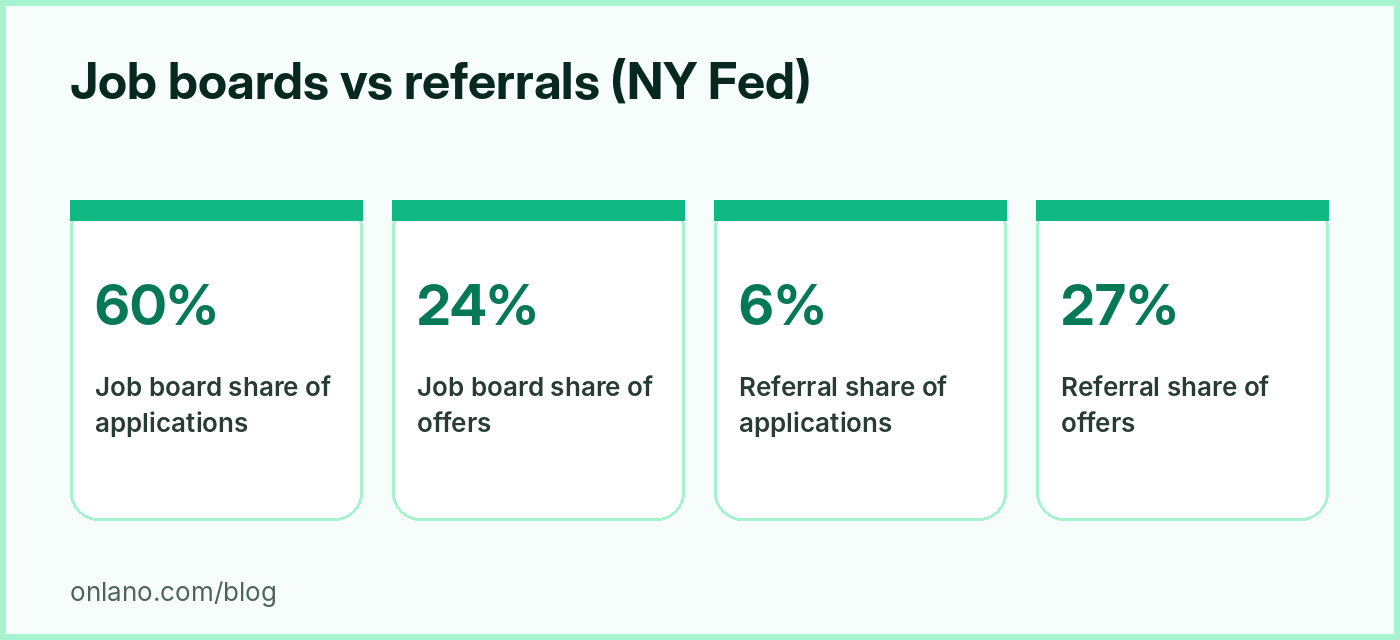
- Don't put all your hours into job boards. A New York Fed presentation found internet job boards produced 60% of applications in its data but only 24% of offers, while employee referrals produced 6% of applications and 27% of offers.
- Fewer, better-targeted applications beat a flood of identical ones. Tailor your resume to the roles you actually want.
- Track every application. By week three you won't remember where you applied or which resume you sent.
- Review results every two weeks. No replies points to your targeting or resume. Interviews with no offers points to interview preparation.
Why a strategy beats "apply everywhere"#
Most people start a job search the same way: open a job board, send out as many applications as they can, and wait. It feels productive because it's busy. It's also the slowest route for many people, for a simple reason. Everyone else is doing the same thing, so every posting attracts a pile of near-identical applications.
A strategy is just a decision about where your hours go. You decide which jobs you're after, which materials you need, how many applications and conversations you'll aim for each week, and how you'll check whether it's working. The rest of this guide walks through that in order. If you'd rather skim, the checklist near the end condenses it to one page.
Step 1: Decide what you're actually searching for#
Vague searches produce vague applications. Before you open a single posting, write down:
- One to three job titles you're qualified for now, or can credibly move into. "Marketing" is not a target. "Content marketing specialist" and "SEO executive" are.
- Your non-negotiables: country or city, work mode (onsite, hybrid, remote), minimum pay, employment type.
- What the typical posting asks for. Open ten postings for your target title and copy the repeated skills, tools and requirements into one list. That list drives your resume, your headline and your search filters.
Stanford's career education office puts the same idea first in its job search action plan: identify your own values, interests, knowledge and skills before you start applying. If you can't yet name a direction, that's a reason to spend a week talking to people (Step 4), not a reason to apply to everything.
Step 2: Build a base resume and profile once#
Write one complete, honest "master" version of your resume that lists your relevant experience, projects and skills, with results instead of duties. Each application then starts as a copy of it. Doing this once saves you from rewriting from scratch every time and keeps your facts consistent.
Our resume writing guide covers structure, bullet writing and formatting for applicant tracking systems in detail. Keep the layout simple enough that software can read it: standard section headings, no text hidden in images, a PDF or DOCX unless the employer asks for something else.
Then update the places employers look. Your LinkedIn or portfolio headline should match your target title. Your contact details should be current and your email address should look professional.
Step 3: Set a weekly plan with real numbers#
A plan turns "I should be looking for work" into specific blocks of time. The UK government's JobHelp service suggests listing the activities you want to do each day, setting how long you'll spend on each, building in breaks and setting realistic daily or weekly targets. McMaster University's Student Success Centre suggests aiming for about an hour a day or five hours a week if that's all you can manage, and growing from there. Both agree on the main point: write it down and keep it up to date.
Here's one way to divide the time, based on Stanford's recommendation, which is to spend 50% of job search time on networking, 25% on preparing materials and applying, 15% on online research and 5% or less on job board sites. It's one career office's recommendation, so treat it as a starting point rather than a law.
Applied to a 10-hour week, it looks like this:
| Activity | Share | Hours (10-hour week) | What it looks like |
|---|---|---|---|
| Networking | 50% | 5 | Messages to contacts, informational interviews, replying to people, attending events |
| Materials and applications | 25% | 2.5 | Tailoring your resume, writing short cover notes, submitting applications |
| Online research | 15% | 1.5 | Studying target companies, reading postings, finding contacts |
| Job boards | 5% | 0.5 | Scanning and saving new listings |
Not everyone should copy that split. If you work in a field where nearly every role is posted publicly and filled by application, you may shift hours toward applying. If you're changing fields, you may need more research time first. The principle that holds up is that no single channel should take all your hours.
Step 4: Put real time into people, not just postings#
This is the step most job seekers skip, and the data suggests it's worth the discomfort.
In a 2017 presentation, a New York Fed economist summarised research on how people find jobs. The slides reported that referrals accounted for about 40% of all offers in the data discussed, and that between one and two thirds of all new jobs are found through referrals. They also cited a study of one firm's hiring in which internet job boards accounted for 60% of applications but 24% of offers, while employee referrals and on-campus recruiting together accounted for 8% of applications but 38% of offers.
Two cautions. First, these numbers come from specific datasets, not from every industry or country, so don't treat them as a universal rule. Second, a more recent look at hiring data from the recruiting software company Ashby, covering over 38 million applications across 93,000 jobs from 2021 to 2024, found that the large majority of applications (93.8%) still arrive as inbound applications and that referrals made up only about 1% of applications. Ashby also reported that 40% of referred candidates went from application to interview. In other words, referrals are a small slice of the pool and a strong signal within it. Both can be true: most applications are inbound, and a referred candidate is more likely to be noticed.
How to start without feeling awkward#
Networking doesn't have to mean cold-pitching strangers for a job. Several university career centers recommend the informational interview: a short conversation where you ask someone about their work.
- Start with people you know. The University of Kansas career center suggests starting with friends and family, even if they don't work in an area that interests you, because they may connect you with someone who does.
- Ask for a specific, small amount of time. Kansas suggests asking for 20 minutes. The University of Illinois career center says to ask for a specific amount of time, mention who referred you, and make it easy, for example by offering a brief phone call.
- Ask questions you can't Google. Georgetown's career center suggests asking things like how people in the field find out about jobs and what organizations the person would recommend you look at.
- Don't ask for a job. Georgetown notes that informational interviews can lead to opportunities, but the goal is to learn.
- Send a thank-you and keep a record. Georgetown recommends noting names, titles, dates and topics discussed, and sending a thank-you right away.
A message that works can be short:
Hi Sana, I saw you moved from support into product operations at [Company]. I'm exploring the same switch and would value 20 minutes of your time next week to hear how you did it. Happy to do a quick call whenever suits you.
Send five of those a week and you will have a handful of conversations a month. It adds up faster than most people expect.
Step 5: Apply thoughtfully, not blindly#
Applications still matter. The aim is to put effort where it pays. A sensible split is to apply quickly to roles that are a rough match, and invest real time in the ones you'd be excited to get.
For each serious application:
- Read the posting properly. Note the must-haves, the tools and the words it repeats. Indeed's career advice team points out that the order of responsibilities often shows what the employer cares about most.
- Tailor your resume to match. Use the posting's wording for skills you really have, and move the most relevant experience higher. Never add skills or experience you don't have; it will come up in the interview.
- Answer screening questions honestly. Questions about work authorization, required licences or minimum experience can end an application automatically, so read them before you submit.
- Use the format they ask for. If none is specified, a text-based PDF or DOCX is a safe choice.
- Apply on the employer's own page when you can. Mississippi State University's career center advises researching employers and applying directly through company career pages when possible.
On Onlano's job listings, at the time of writing you can filter by category, country, salary, work mode, job type and company, save jobs to come back to, upload a CV and use easy apply. Filters are the quickest way to cut a list of thousands to the dozen that fit your non-negotiables from Step 1. Onlano showed more than 11,000 live roles when this guide was written, but that count changes daily, so treat it as a snapshot.
Step 6: Track every application and follow-up#
By the third week you won't remember where you applied. A spreadsheet is enough. Record, for each application:
| Column | Example |
|---|---|
| Company and role | Northwind Logistics, Operations Analyst |
| Date applied | 14 Oct |
| Where you found it | Onlano listing / referral from Sana |
| Resume version sent | Operations v2 |
| Link to posting | (paste the URL; postings get taken down) |
| Contact | Name and email if you have one |
| Status | Saved, Applied, Screening, Interview, Offer, Closed |
| Next step and date | Follow up on 21 Oct |
That last column is the one people forget. Mississippi State's career center suggests following up with employers and professional contacts as part of a weekly routine, and tracking applications, follow-ups and interviews. A follow-up can be as short as two lines about a week to ten days after applying: restate your interest, mention one specific thing you could contribute, and thank them for their time. If you have the name of a person at the company, send it to them rather than a generic inbox.
Step 7: Review every two weeks and adjust#
Once a fortnight, look at the tracker and ask what the numbers say:
| What you see | What it likely means | What to change |
|---|---|---|
| Many applications, almost no replies | Targeting or resume isn't matching what employers screen for | Re-read postings, tighten your titles, tailor harder, get a second opinion on the resume |
| Replies but few interviews | Applications get a look but something in the screening stage fails | Check screening answers, salary expectations, work authorization and availability |
| Interviews but no offers | Interview performance or fit | Practise with our interview preparation guide, collect feedback, tighten your stories |
| Offers that are below your target | Pay research gap | Use the salary research and negotiation guide before the next conversation |
| Lots of conversations, no leads | Networking is friendly but unfocused | Ask each person for one specific introduction or one company to look at |
Change one thing at a time so you can tell what worked.
Special situations#
Searching while employed. You have less time and more leverage. Keep the weekly plan small (three to four hours), be careful with who you tell, and use evenings for networking and applications. Never use your employer's equipment or email for the search.
Changing careers. Expect to spend more of your time on research and conversations, and to build a bridge: a project, a course, or a role that borrows skills from both fields. A tailored resume that leads with transferable results matters more than your last job title.
Searching for remote roles. Competition is wider because anyone can apply, so your application needs to show you can work independently. Our remote jobs guide covers where to look and how to avoid scams.
Long searches. Searches take as long as they take, and a bad week doesn't mean the plan is broken. Keep the routine, keep some time free for rest, and ask one person each week for feedback or an introduction. If you're stuck, a career center, alumni service or public employment service can often review your materials for free.
One-page job search checklist#
- To do: I've chosen one to three target titles and written my non-negotiables
- To do: I've collected repeated requirements from ten postings for my main target
- To do: My base resume is complete, honest and simple to parse
- To do: My LinkedIn or portfolio headline matches my target
- To do: I've blocked weekly hours and set targets for networking, applications and research
- To do: I've listed ten people to contact and sent the first five messages
- To do: I tailor my resume for every application I care about
- To do: I log every application, resume version and next step in a tracker
- To do: I follow up within about a week to ten days
- To do: I review the tracker every two weeks and change one thing
In this guide series#
This guide is the overview. Each of the following posts goes deeper on one topic. More are on the way.
- More guides in this series are coming soon.
You may also want our broader guides: the resume writing guide, the interview preparation guide and the salary research and negotiation guide. If you're new to the platform, Meet Onlano explains how it works.
Frequently asked questions#
How many jobs should I apply to each week?#
There's no number that fits everyone. A common approach is to set a weekly target you can sustain, for example five to ten tailored applications alongside your networking time, then adjust using your two-week review. If you send many applications and hear nothing, sending more of the same won't help; fix targeting or your resume first.
Is networking really better than applying online?#
They work together. The New York Fed presentation summarised above found referrals produced a much higher share of offers than of applications, while Ashby's data shows most applications still arrive inbound. Do both, and don't let job board browsing take all your time.
What if I don't know anyone in my field?#
Almost nobody starts with a perfect network. University career centers suggest beginning with family, friends, former classmates, professors, alumni and members of professional associations, and asking each person whether they know someone else you could talk to.
How long does a job search take?#
It varies widely by field, location, seniority and the market, and the sources we reviewed don't give a single reliable figure, so we won't quote one. Plan for weeks to months, build a routine you can keep up, and use your tracker to see whether your effort is producing conversations.
Should I tailor my resume for every application?#
For roles you really want, yes. Start from your master resume and adjust the summary, bullet order and keywords for skills you genuinely have. For rough-match roles you apply to quickly, a lightly adjusted version is usually enough.
Sources#
- How Do People Find Jobs? Federal Reserve Bank of New York (Topa, June 2017)
- Are referred candidates more likely to get hired? Ashby Talent Trends Report
- Action Plan: Organizing Your Job Search, Stanford Career Education
- Step 4: Make a plan, JobHelp (UK government)
- Job Search Weekly Scheduler, McMaster University Student Success Centre
- Search for a Job/Internship, Mississippi State University Career Center
- Informational Interviewing, University of Kansas University Career Center
- Informational Interviews, University of Illinois Urbana-Champaign Career Center
- Informational Interviews, Georgetown University Cawley Career Education Center
- Tailoring Your Resume to a Job Description, Indeed Career Advice
About the author. Onlano Editorial writes practical career and hiring guides for job seekers and employers on Onlano. Figures and advice above are attributed to the sources listed; check each employer's own instructions before you apply.