Remote Jobs: How to Find, Win and Succeed in Remote Work
A practical guide to remote jobs: what 'remote' really means, where to look, how to spot scams, how to tailor your applications and interviews, and how to settle in once you're hired.
"Remote" isn't one thing. Some companies hire from anywhere, some only in certain countries or states, and some say remote but expect you in an office a few days a month. Read the posting for the exact terms before you apply.
Remote roles draw applicants from far beyond one city, so your application has to show clearly that you can work without someone looking over your shoulder.
Scams are the biggest risk. A real employer never asks you to pay to get a job, and never needs your bank details or ID before an interview.
Written communication carries most of the weight. Many remote teams run on text, documents and recorded video rather than meetings.
The first month in a remote job decides a lot. Set up your space, your hours and your connections on purpose, because nobody will do it for you.
A remote job is one you can do from somewhere other than an employer's office. That sounds simple, but job postings use the word loosely, and the differences matter once you're hired.
GitLab, one of the best-documented fully remote companies, says in its handbook that in an all-remote organization each person is free to work and live where they're most fulfilled, and that different companies take very different approaches to remote work. The practical lesson: ask how company defines it, because the label alone tells you little.
No office. You choose your location, sometimes within limits
Time zone overlap, legal right to work, tax rules
Remote, country or region restricted
You work from home but must live in specific countries or states
Whether the restriction is for payroll, legal or time-zone reasons
Remote-first
Documents and decisions happen online even if an office exists
Whether remote staff are treated the same as office staff
Hybrid
A few days in an office each week or month
Commute distance, how often, who decides the days
Remote with travel
Mostly home-based, with trips to meet the team or clients
Travel frequency, who pays, how much notice you get
Freelance or contract remote
You're paid per project or hour, and you're usually self-employed
Contract terms, payment schedule, who owns the work
That last row deserves a closer look. The U.S. Internal Revenue Service explains that whether someone is an employee or an independent contractor depends on the degree of control and independence in the relationship, looking at behavioral control, financial control and the type of relationship (such as written contracts and benefits). Generally, an employer withholds income and payroll taxes for employees but not for contractors. Countries differ, so treat the IRS page as one example of the issue. The point is that a "remote job" paid as a contractor means you handle your own taxes and usually receive no benefits, and you should know that before you say yes.
Remote work grew sharply and then settled at a level well above where it started. The WFH Research project, run by economists including Nicholas Bloom and Steven Davis, tracks this through its monthly Survey of Working Arrangements and Attitudes, which covers between 2,500 and 10,000 U.S. residents aged 20 to 64. The project's headline findings are that working from home was already growing before the pandemic and is now permanently higher, and that employer plans for post-COVID working from home have tracked actual working from home since 2022. Its data page lists the most recent release dates, and the survey data is free to download if you want to look at the current numbers yourself.
Harvard Business Review authors Barbara Larson, Susan Vroman and Erin Makarius noted back in March 2020 that close to a quarter of the U.S. workforce already worked from home at least part of the time before the pandemic forced the rest to follow. Remote work is not a fad that arrived with COVID, and it isn't going away. It is, however, not available in every occupation, so be realistic about whether your field offers it.
Jobs that run on a laptop and a connection are the most portable. Common examples include:
Software development, QA and DevOps
Design: UX, graphic, product and motion
Marketing, SEO, content and social media
Writing, editing and translation
Customer support and account management
Data analysis and operations
Recruiting, HR and administration
Sales and business development
Online teaching and tutoring
Jobs that depend on physical presence, such as most healthcare, construction, hospitality and manufacturing roles, are rarely remote. If you work in one of those fields, look for adjacent roles (scheduling, training, support, content) that can move online rather than waiting for your exact title to go remote.
Typing "remote" into a search box finds postings that mention remote work, which isn't the same as postings that offer it. Use a work-mode filter instead, then read each description. On Onlano's job listings, at the time of writing you can filter by category, country, salary, work mode, job type and company. That lets you combine "remote" with your field and a country in a few clicks. Onlano also showed more than 11,000 live roles when this guide was written, but the count changes daily, so treat it as a snapshot.
A job board with real filters. Good for volume and for comparing salaries across postings.
Company career pages. Make a list of 15 to 20 companies you'd like to work for, including fully remote ones, and check their careers pages weekly. GitLab's handbook points out that targeting companies built for fully remote work spares you the negotiation over whether you may work remotely at all.
Communities in your field. The GitLab handbook suggests remote-worker communities on LinkedIn, Reddit and We Work Remotely as places to learn from people who already do the job.
Your own network. Former colleagues, classmates and clients know about openings that never get posted.
Remote roles attract scammers because the whole process happens online and nobody meets you in person. The FBI's Internet Crime Complaint Center warns about fake work-from-home jobs that involve a simple task, such as rating restaurants or "optimizing" a service by repeatedly clicking a button. According to the FBI, the scammer may pose as a legitimate staffing or recruiting agency, may reach you through an unsolicited call or message, and often builds a confusing pay structure that requires you to make cryptocurrency payments to "unlock" work. A fake interface then shows you earning money that you can never withdraw.
The FBI lists three red flags:
You're told to make cryptocurrency payments to your employer as part of the job.
The job description uses the word "optimization" and involves relatively simple tasks.
The scammer doesn't ask for any references during hiring.
Its protection tips are short and worth memorizing: be cautious with unsolicited job messages and avoid clicking links or opening attachments in them, never send money to an alleged employer, and don't send financial or personally identifiable information to people who make unsolicited job offers.
Add a few checks of your own:
Search for the company separately. Don't use the link in the message. Find the official website, locate the same role on its careers page and contact them through details listed there.
Watch the channel. A "recruiter" who insists on moving a first conversation to a chat app, and who never gets on a video call, deserves suspicion.
Be wary of equipment checks. If a new employer sends a check and tells you to deposit it and send part of the money elsewhere, stop. That's a classic pattern, and the bank will eventually reverse the check.
Slow down. Pressure to act today is a tactic, not a hiring process.
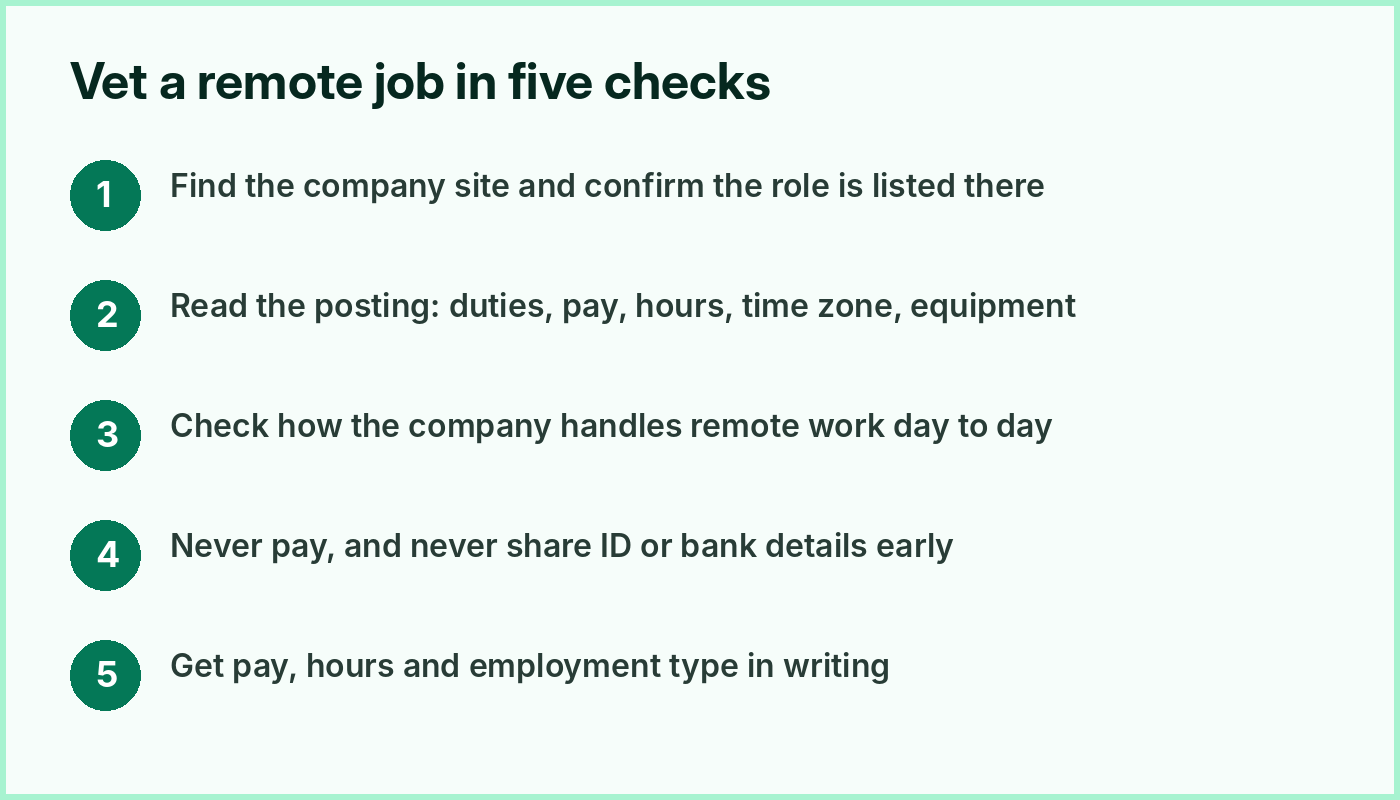
Five checks to run before you share personal details or accept an offer.
Sorry to be blunt, but if you've already paid or shared bank details, contact your bank immediately and report it to the FBI's IC3 at ic3.gov as the FBI requests. Reporting won't always get money back, but it's the first step.
Hiring managers for remote roles tend to get applications from many places at once. That raises the bar for showing, not telling, that you can work independently.
Lead with results that show self-direction: projects you owned, work you delivered with little supervision, and anything you did with distributed teams, clients in other time zones or online tools. Name the tools you've used for collaboration, documentation and project tracking, but only the ones you really know. Our complete guide to writing a resume walks through the structure, and the same rules apply: keep it scannable and match the wording of the posting.
Keep it short and specific. Say why this company and this role, where you're based and your working hours or time-zone overlap, and one example that proves you can deliver without close oversight. If the posting asks about your remote setup, answer plainly: reliable internet, a quiet workspace, a backup connection.
Remote employers can't observe you in person, so they look you up. Make sure your profile, portfolio or code samples are current and consistent with your resume. If your work is private, prepare a short write-up of one project with the problem, what you did and the outcome.
Everything about a remote interview happens through a screen, so treat the setup as part of your preparation.
Test your tech. Check your camera, microphone, lighting and connection the day before, and keep a phone hotspot ready as a fallback. The GitLab handbook specifically recommends remote workers consider a backup connection, such as a phone plan that supports tethering, because they're responsible for their own connectivity.
Expect questions about how you work alone. Interviewers want to know how you plan your day, handle a blocker when nobody's nearby, communicate progress and deal with different time zones. Prepare two or three short stories with a situation, what you did and what happened. Our job interview preparation guide covers the standard answer structures.
Ask questions that reveal how remote work really functions. The GitLab guide advises candidates to learn during the interview how the company defines remote work, whether that matches their working style, and how communication happens. Good questions include:
How do teammates communicate: chat, documents, recorded video, meetings?
What are the expected working hours, and is there required overlap with a time zone?
How is performance measured?
Does the company provide equipment, or reimburse a home office or coworking space? (GitLab notes that not all remote employers provide equipment, so this is worth asking.)
How does onboarding work for someone who has never met the team?
Since many remote jobs are paid in a different currency or under a contract, don't skip the money conversation. Our guide to researching and negotiating your salary shows how to build a range and counter an offer, and the same principles apply to day rates and contract fees.
The GitLab handbook's guide to starting a remote job is a good reference for this stage. Its main themes translate to any employer:
Expect different onboarding. You may learn mostly through documents, videos and video calls. Be ready to ask questions, take notes and introduce yourself.
Read the documentation first. If the company writes things down, the answer is probably already there. That's a time saver and shows initiative.
Design a workspace for focus. GitLab suggests picking a place that's free of distractions and, if possible, a space used only for work so you can switch off when you leave it. If home doesn't suit you, try a coworking space.
Agree on routines with the people you live with. Being visible at home can signal that you're available. Tell family or housemates your working hours.
Build connections on purpose. The handbook advises being intentional with coffee chats, team calls and informal channels, because the hallway conversations of an office won't happen by themselves.
Set work-life boundaries. Plan time off, close the chat and email apps when you finish, and use calendar working hours so teammates in other time zones know when you're available.
Protect your mental health. Isolation is real. Schedule breaks with other people, try a coworking space, and use video calls when it's practical.
Check ergonomics. Seat, posture and wrist position matter more when your "office" is a kitchen table. Ask whether the employer reimburses equipment.
Also learn the communication style quickly. GitLab describes itself as an asynchronous company in which much communication is text, and it advises new hires to ask co-workers about their preferred ways to be contacted and to use them. Many remote teams work like that: write clearly, include context, state what you need and by when, and don't expect an instant reply.
Onlano is free for candidates. At the time of writing, the job listings let you filter by work mode, country, category, salary, job type and company, save jobs for later, upload a CV and use easy apply. A practical routine is to save a filtered search for your field, review new roles a couple of times a week, and tailor a short version of your resume for each. If you're new to the site, Meet Onlano explains how it works.
Find the company's official website independently and check that the same role is listed on its careers page. A legitimate employer interviews you, doesn't ask you to pay for equipment, training or "unlocking" work, and doesn't need bank or ID details before hiring. The FBI advises never sending money to an alleged employer.
Can I work remotely for a company in another country?#
Sometimes. Many postings restrict hiring to certain countries or states for legal, tax or payroll reasons, and others hire contractors anywhere. Read the location line closely and ask how you'd be paid and classified. Rules vary by country, so check local requirements.
It depends on the employer. Some companies set pay by the location you live in, others pay one rate for everyone, and contractors set rates themselves. Ask in the first conversation how pay is determined for remote staff, and use the salary research methods in our salary guide.
Clear writing, self-management, comfort with online collaboration tools and the ability to work without close supervision. GitLab's handbook uses the phrase "manager of one" for the self-direction it expects from remote team members.
It can be, though competition is higher because anyone can apply. Entry-level candidates improve their odds with a portfolio or sample work, a clear explanation of how they'll stay productive alone, and companies that have documented onboarding for new remote hires.
About the author.Onlano Editorial writes practical career and hiring guides for job seekers and employers on Onlano. Figures and advice above are attributed to the sources listed; check each employer's own instructions before you apply.
Onlano is a fast, free-for-candidates job portal with 11,300+ live roles, 4,754+ hiring companies and one-click apply. Here is what it does, who it is for and how it works.
A practical job search strategy in seven steps: pick targets, build a base resume, split your time between networking and applications, track everything, follow up, and review what's working every two weeks.
A practical guide to job interview preparation: decode the job post, research the employer, build STAR stories, rehearse, prepare your own questions, handle video and in-person logistics, and follow up.