How to Research and Negotiate Your Salary: A Complete Guide
A practical guide to salary negotiation: how to research a fair range, answer 'what are your expectations?', counter an offer, weigh benefits, ask for a raise and read pay transparency rules.
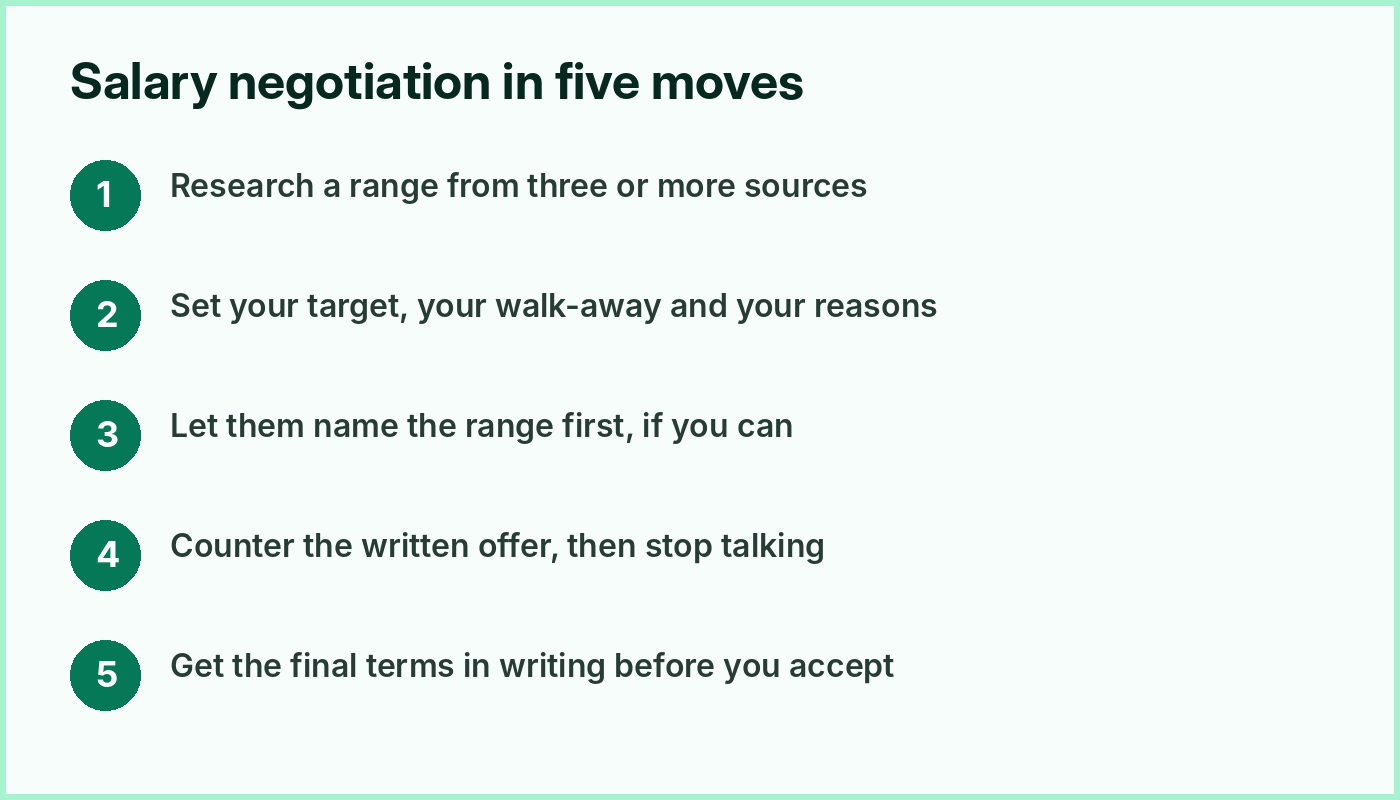
Do the research before the conversation, not during it. Pull numbers from several sources and look for where they agree. A figure you can explain is a figure you can defend.
Think in ranges. Know your target, your minimum and the reasons behind both.
When salary comes up early, ask for the employer's range first. If you have to answer, give a tight range based on your research, not one hopeful number.
Negotiate after you have a written offer, and negotiate the whole package, not only base pay.
Stay polite, never bluff, and get the final terms in writing.
Negotiating works on average, but it isn't magic. The numbers below come from one specific study, and your result will depend on the employer, the role and the country.
Why salary negotiation is worth the awkward five minutes#
Most people dislike talking about money with someone who's about to become their boss. That discomfort is expensive.
The New York State Department of Labor puts it bluntly in its salary negotiation guide: skipping the conversation can cost you thousands of dollars, and the effect compounds because employers at your next job often anchor on your current or previous salary. If you start low, you tend to stay low. (Asking about salary history is restricted in some places, so the practice varies by location.)
There's some evidence that asking pays off. A study by Michelle Marks and Crystal Harold, summarised by Harvard Law School's Program on Negotiation, surveyed 149 professionals who'd been hired in the previous three years. Those who negotiated rather than accepting the first offer raised their starting pay by an average of $5,000. Competitive and collaborative styles were linked to the gains. Simply compromising or accommodating wasn't.
Treat that as one study of a specific group, not a promise. A $5,000 average hides plenty of people who got nothing and a few who got much more. But the downside of asking politely is usually small, and the upside carries into every later raise and job change.
Skip the single "average salary" number. Averages blend junior and senior people, big cities and small towns, and different employer sizes. You want a range for your role, level and location, and you want it from more than one place.
NYU Libraries' career guide makes the same point: pay is shaped by job title, seniority, industry and geography, so collect figures from as many sources as you can and look for consensus. It lists several types of source:
Source type
What it's good for
Watch out for
Government wage data (in the US, CareerOneStop and the Occupational Outlook Handbook, per NYU)
Reliable occupation-level ranges
Broad job categories; may lag the market
Salary calculators and surveys (Salary.com, Payscale, recruiter salary guides)
Quick ranges by title and city
Methods differ; some are self-reported
Employee-reported sites (Glassdoor, The Salary Project)
Real figures from named employers
Small samples; can be outdated
Professional and trade association surveys
Industry-specific detail
Often behind a membership paywall
Live job postings
What employers are offering right now
Ranges can be very wide or missing
Your network
Context no database has
One person's pay isn't the market
Robert Half adds a sensible habit: look at three or four live postings at a similar level to see what companies are advertising today. If the job is remote or hybrid and you don't know which location the company benchmarks against, check both the company's office city and your own.
If you're comparing an hourly rate with a salaried job, convert them properly before you compare. Onlano's hourly to salary calculator takes an hourly wage, hours per week and a US state, then shows an estimated gross annual salary and take-home pay after taxes. At the time of writing, its example for $35 an hour at 40 hours a week in Texas works out to $72,800 gross a year, with an estimated net figure shown beside it. The tax part is an estimate, not tax advice, and it covers the US, Europe and the UK, so don't treat it as a substitute for a payslip.
Target. The figure you'd be happy with, supported by your research.
Stretch. The top of the range you could justify if the employer is generous.
Walk-away. The lowest figure you'd actually accept. The New York DOL guide says to never accept less than your minimum, so decide it in advance, when you're calm.
Robert Half's advice on ranges applies here too: the bottom of any range you share should be a number you'd truly say yes to. If it isn't, you're negotiating against yourself.
A number without reasons sounds like a wish. The DOL guide warns against arbitrary figures: know why you're asking for a specific salary and be able to defend it.
Your reasons should be about the job, not your bills. Good ones include:
Skills the posting asks for that you already use well
Responsibilities beyond what's listed (managing people, owning a budget, covering two functions)
Results you can describe in a sentence, ideally with a figure (the same bullets that make a strong resume; our resume writing guide shows how to write them)
Market data showing the role pays more than the first offer
A competing offer, if you have one and it's real
Weak ones: "I need more because rent went up," "my friend makes more," or anything you can't back up.
Harvard's Program on Negotiation, drawing on Deborah Kolb and Jessica Porter, also suggests two prep moves people skip. First, develop alternatives, because your leverage depends partly on what you'd do if this deal fell through. Second, look at your own vulnerabilities in advance. If there's a gap in your work history, decide how you'll talk about it so it doesn't make you flinch at the table.
Step 3: Handle "What are your salary expectations?"#
This question often lands before there's an offer, sometimes on an application form or a recruiter's first call. You have three reasonable options, and which you choose depends on how much you know.
Option A: Ask for their range first. Robert Half says it's fine to ask about the budgeted range before giving yours, especially in a recruiter screen. New York's labor department suggests similar wording. A script you can adapt:
"Thanks for asking. Could you share the range budgeted for this role? I'd like to make sure we're in the same ballpark before we go further."
Option B: Give a researched range. If they press, give a range you've worked out and link it to the role. Robert Half's example of a spread that looks deliberate is $85,000 to $95,000; a $70,000 to $110,000 spread suggests guessing. Something like:
"Based on the role and current pay in this market, I'm looking at $X to $Y. That reflects my experience with [specific requirement]."
The NY DOL guide adds a caution worth remembering: the employer may treat the top of your range as your ceiling and try to pull the number down, which is why the bottom must be a figure you can live with.
Option C: The "non-offer offer". Harvard's Program on Negotiation describes an approach from David Lax and James Sebenius. Instead of "I deserve $80,000," you say something closer to "I've heard people in similar roles earn $80,000 to $90,000." It sets a reference point without sounding like a demand. It only works if the figure is credible, so it comes back to your research.
What to skip: a flat refusal to talk numbers at all. Some people do this and sometimes it works, but you can come across as evasive. Deflecting politely once is fine. Refusing three times isn't.
The NY DOL guide says that traditionally salary talks start when an offer is made and you counter. It also says it's acceptable, in an era of more pay information, to raise the range during a first interview, and that many employers expect it. My read: ask about the range early so nobody wastes time, but save the actual haggling for when there's an offer on the table.
When the offer arrives:
Show enthusiasm first. You want the job; say so.
Don't accept on the spot. Ask for a reasonable window, such as 24 or 48 hours, per the DOL guide, and keep to it. Allow for weekends and holidays.
Ask for the offer in writing, so nothing about the package is ambiguous.
Keep emotion out of it. Sleep on it. Run the numbers with someone you trust.
State your appreciation, name the specifics you want changed and give your reason. Here's an example script for a counter by phone or video:
"Thank you, I'm excited about this role and the team. Based on the responsibilities we discussed and what I'm seeing for similar roles in this market, I was hoping for something closer to $X. Is there room to get there?"
Then stop talking. The silence feels long. Let them fill it.
Some guardrails from the DOL guide:
Negotiate in good faith: only if you'd seriously take the job.
Be clear about which parts of the offer you want to improve.
Don't negotiate by text message. The guide calls it disrespectful to the process. A call or email is better.
It happens, especially at companies with fixed pay bands. Harvard's Program on Negotiation notes that large, established employers often slot candidates into defined categories with set salary ranges, and you may be talking to HR or a recruiter, not your future manager. In that setting, work out which band someone with your education and experience would fall into and make your case for the high end of it.
If base pay really is capped, move to the other items on the table (next section). If nothing moves and the offer is under your walk-away, you can decline politely. That's the whole point of having a walk-away number.
Base salary gets the attention, but the DOL guide notes that non-salary benefits are often easier to negotiate, and lists examples: commissions and bonuses, work schedule or remote options, paid time off, insurance, retirement contributions, tuition or student loan help, equity, commuting costs and wellness perks.
Which matters depends on your life. A comparison helps:
Item
Questions to ask
Why it can beat a small raise
Bonus or commission
How is it calculated? What share of people hit target?
Can be large, but only if it's actually paid
Paid time off
Days per year? Rollover?
Time off has a value you'd otherwise pay for
Remote or flexible schedule
Fixed in writing, or at manager discretion?
Saves commuting cost and time
Retirement contribution
Does the employer match?
Free money, if you'd contribute anyway
Equity
Vesting schedule? What's it worth realistically?
Can be worth nothing at an early-stage startup
Learning budget
Annual amount? Approval rules?
Grows your next salary
Start date and review date
Can an early review be written in?
A guaranteed look at pay in six months
Harvard's Program on Negotiation notes that a start-up recruiting its third employee has more latitude to design a creative package, including stock options, than a large company with fixed bands. Equity can be generous on paper and worthless in practice, so ask how it works before it counts as money in your head.
A raise is a negotiation too, with different timing and different evidence.
The New York DOL guide says an annual review after a year in the role is the most appropriate time, though six months can work if you can show specific results. Another opening is when you're handed extra responsibilities. If the new work adds to your existing tasks, it's fair to ask whether the pay can reflect that. The guide gives wording along these lines: you'd like to take it on, it will take extra preparation time, and you'd like to talk about pay for it.
Harvard's Program on Negotiation says one of the most common mistakes is asking without enough preparation. Look at the company's financial health, whether raises are happening elsewhere in the organisation, cost-of-living changes since your last raise, time since your last adjustment, any promotion that came without a pay change, and market benchmarks. If you're told no, ask what milestones would justify a raise later and write them down.
A raise request that includes a deadline threat ("raise me or I leave") only works if you're prepared to leave. Don't use it as a tactic unless it's true.
More job ads now show pay. The Federal Reserve Bank of Minneapolis reports that since 2019, cities and states in the US have increasingly required employers to include pay ranges in postings. Using Indeed data, it found that Colorado, Washington, California and New York each saw an increase of more than 50 percentage points in the share of ads with pay information between 2019 and 2023, while other states rose by 27 percentage points. Compliance was still imperfect.
For a job seeker, the benefit is simple: better information to decide where to apply and what to ask for. The Minneapolis Fed also points out limits. Some ranges are so wide they're useless; it cites examples in New York of $50,000 to $180,000 and $140,000 to $450,000. Rules differ by state on who must comply, what must be included (some require benefits descriptions, some only the pay range) and how remote roles are treated.
Two practical takeaways. If a posting has a range, treat it as a starting point and check it against your own research. And on a job board, use pay filters to narrow your search. On Onlano's jobs page, you can filter by salary along with category, country, work mode and job type, and listings that publish a pay range show it on the page. At the time of writing, Onlano is free for candidates. Plenty of postings still don't show pay, so your own research stays necessary.
Everything in this section is about US rules. Laws elsewhere differ, so check your own country's labour department.
No. The New York State Department of Labor says most employers expect you to take time to consider an offer, and treats negotiation as a normal part of the hiring process. Be polite, specific and ready to explain your number. Norms differ by country and company size, and some employers (large ones with fixed bands, public bodies) have little room to move.
When should I bring up salary in the hiring process?#
The DOL guide says the traditional moment is when you have an official offer, but it's acceptable to ask about the range in a first interview. Robert Half suggests asking for the employer's budgeted range during a recruiter screen. Avoid raising it before you've been invited to interview.
There isn't a universal percentage, and I'd distrust anyone who gives you one. Base your ask on your research and your reasons. In the Marks and Harold study summarised by Harvard, the average gain for people who negotiated was $5,000, but that's an average for one group, not a target.
What if the employer says the salary is non-negotiable?#
Ask about everything else: bonus, schedule, time off, learning budget or an early pay review. The DOL guide notes non-salary benefits are often easier to negotiate. If none of it works and the total is under your minimum, decline politely and keep the relationship open.
Yes, with more care. The NY DOL guide says the traditional offer-then-counter approach tends to work well for entry-level and lower-paid roles. Keep the ask modest, tie it to research and focus on a couple of items, such as a review date or a learning budget.
About the author.Onlano Editorial writes practical career and hiring guides for job seekers and employers on Onlano. Figures and advice above are attributed to the sources listed; salary norms vary by country, employer and role, so check local rules before you negotiate.
A practical job search strategy in seven steps: pick targets, build a base resume, split your time between networking and applications, track everything, follow up, and review what's working every two weeks.
A practical, step-by-step guide to writing a resume: pick a format, write a summary, build strong bullets, get past applicant tracking systems and proofread before you apply.
A practical guide to remote jobs: what 'remote' really means, where to look, how to spot scams, how to tailor your applications and interviews, and how to settle in once you're hired.