

Key takeaways#
- Tech hiring is concentrated in a handful of areas: AI and machine learning, security, data, cloud and DevOps, and general software engineering. Employer surveys in 2026 keep naming the same ones.
- Skills beat job titles. The same title can mean different work at different companies, so read the skill list in a posting, not just the headline.
- Creative roles (design, UX, marketing, content) overlap with tech more than they used to. Employers want people who can work with developers, data and AI tools, and who can show finished work.
- Proof matters more than claims. A small portfolio, a few shipped projects or a verified assessment says more than a long skills list.
- Pay ranges below come from one staffing firm's U.S. salary guide. Treat them as a snapshot for orientation, not a promise, and check local data before you negotiate.
What "tech and creative careers" covers#
People use "tech career" for two different things. The first is a technical role: someone who builds, runs or secures software and data systems. The second is any role at a technology company or on a digital product, such as design, marketing, support or project management.
CompTIA's State of the Tech Workforce 2026 draws the same line. It describes the tech workforce as technology professionals in technical positions (IT support, network engineering, software development, data science and related roles) plus business professionals employed by technology companies, such as sales, marketing, finance, HR and operations. It also notes that about 40% of tech professionals work for technology companies, while the other 60% work in every other sector of the economy.
That second number is worth sitting with. Most tech jobs aren't at tech companies. Banks, hospitals, manufacturers and public agencies all hire developers, data people and security staff. If you only search "tech company" listings, you'll miss most of the market.
Creative careers sit right next to this. A product designer, a motion designer, a content strategist and a performance marketer all work on digital products and often alongside engineers. This guide treats them together because the skills increasingly overlap and so do the hiring channels.
Where demand is right now#
No single survey tells the whole story, so it helps to read several and look for the overlap. These are the ones we fetched and read for this guide.
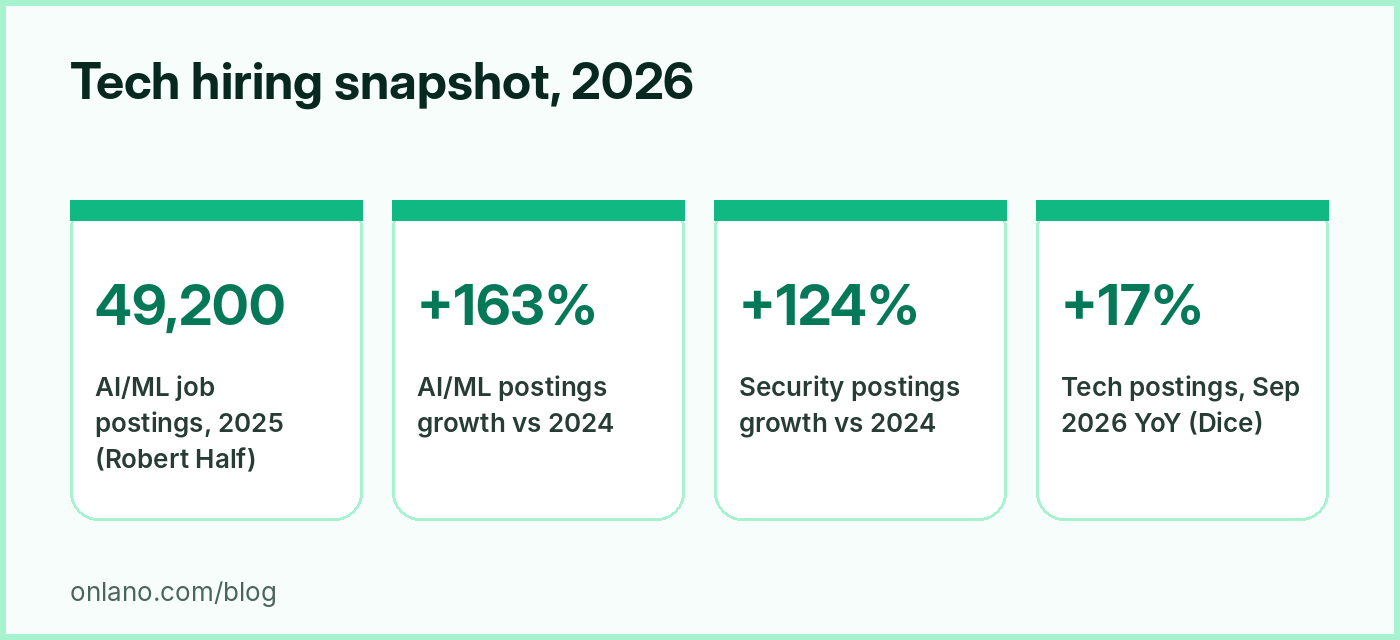
- Robert Half analysed U.S. job postings and reports that employers posted nearly 1.1 million technology and IT jobs in 2025. AI, machine learning and data science roles totalled 49,200 postings, up 163% from 2024. Security roles reached 66,800 postings, up 124% year over year.
- Dice's September 2026 report says tech job postings rose 9% month over month and 17% year over year. AI and machine learning postings grew 88% year over year, about five times the growth rate for tech postings overall.
- CompTIA, citing U.S. Bureau of Labor Statistics and Lightcast projections, expects the tech workforce to grow twice as fast as the overall U.S. workforce over the next ten years. It names data scientists and analysts, cybersecurity analysts and engineers, software developers and engineers, IT managers and software QA and testers as the occupations driving that growth.
- Reveal's 2026 IT talent survey of 250 senior technology leaders found the hardest roles to fill were AI engineers (39%) and cybersecurity engineers (38%), followed by cloud engineers (25%) and data analytics professionals (24%).
- Ceipal looked at nearly 20,000 IT and engineering postings and found project managers were the most in-demand role going into 2026, ahead of business analysts, data engineers and software engineers.
Those sources don't agree on the exact ranking, and they shouldn't, because they measure different things (postings, leader surveys, projections). What they share is the pattern: AI, security, data and infrastructure sit near the top, and project and business-analysis roles that connect technical work to business goals are hiring steadily too.
A caution on all of this. These are mostly U.S. figures. If you're hiring or job hunting elsewhere, the direction may match but the numbers won't. Use them to understand which skills are valued, then check local listings.
The main tech career paths#
Here is each major path in plain terms, with what the work looks like and what to learn first.
Software development#
Developers build and maintain the applications behind products and internal systems. Robert Half notes that demand is especially strong for engineers who can integrate AI-driven features. Within this path there are several lanes:
- Frontend developers build what users see and click. The roadmap.sh frontend guide describes the role as using HTML, CSS and JavaScript to build the visual and interactive parts of websites and applications, keeping interfaces responsive and accessible, and working closely with designers, back-end developers and project managers.
- Backend developers build the services, APIs and databases behind the interface.
- Full stack developers work across both, which is common at small companies and startups.
- Mobile developers build iOS and Android apps, or cross-platform apps.
The language you pick matters less than going deep on one stack. Reveal's survey lists Python as the most requested technical skill (56% of respondents), with AI and machine learning at 47%, Java at 34% and cybersecurity at 33%. Python is a sensible first language if you're undecided, because it opens doors in web development, automation and data.
Data and AI#
This path covers analysts, data engineers, data scientists and AI/ML engineers. They differ more than the titles suggest:
- Data analysts answer business questions with SQL, spreadsheets and dashboards.
- Data engineers build and manage the databases and pipelines that analysts and models depend on.
- Data scientists apply statistics and modeling to prediction and personalization problems.
- AI/ML engineers design, deploy and maintain the models behind automation and product features.
If you're new, analytics is the gentlest entry. SQL and a visualization tool get you to a first job faster than a machine learning specialization does, and the later moves are easier once you know how messy real data is.
Cybersecurity#
Security work spans analysts who monitor and respond, engineers who build defenses, and architects who design secure systems. Robert Half reports cybersecurity engineers alone accounted for 20,000 new job posts in 2025, and Dice's September 2026 report lists Security Architects and Infrastructure Security Engineers among the titles with the fastest month-over-month growth. Entry usually goes through IT support, networking or a junior analyst role, not straight into engineering.
Cloud, DevOps and infrastructure#
Cloud and network engineers keep platforms running across hybrid and distributed environments. DevOps engineers improve pipeline reliability, automate workflows and connect development, operations and security teams. These roles reward people who like systems more than screens, and who are comfortable on Linux, containers and one major cloud provider.
QA, project and product roles#
Software QA and testing appears on CompTIA's list of growth occupations. Project managers topped Ceipal's 2026 ranking. These are good routes if you're organized and communicate well but don't want to write production code all day. They also lead naturally into product management.
Creative careers that sit beside tech#
You don't need to write code to build a career on digital products. The common creative paths are:
- UI/UX and product designers, who research users, design flows and build design systems. Work closely with frontend developers.
- Graphic and brand designers, who produce identity, campaign, print and digital design.
- Digital marketers and content specialists, who run search, social, email and paid campaigns and write the copy behind them.
- Motion, video and media producers, who make product videos, ads and social content.
We didn't find a single authoritative source we could verify for creative-role demand numbers in this research pass, so we won't quote any. What we can say from the tech reports is that skills such as critical thinking and adaptability are rising in value as AI takes over more routine work. Robert Half's analysis says so directly for tech roles, and the same logic applies to creative work: tools that generate a first draft raise the premium on judgment, taste and clear briefs.
If you're choosing between creative and technical, it's not an either-or. A designer who can write front-end code, or a developer who understands visual hierarchy, is easy to place on a product team.
What these roles pay (a snapshot)#
The table below uses starting salary ranges from Robert Half's 2026 Salary Guide, as published in its technology hiring article. They're U.S. national figures in dollars and describe starting pay, so they won't match your local market.
| Role | Low | Mid | High |
|---|---|---|---|
| AI/ML engineer | $134,000 | $170,750 | $193,250 |
| Data engineer | $127,000 | $156,250 | $180,750 |
| Data scientist | $121,750 | $153,750 | $182,500 |
| DevOps engineer | $118,000 | $145,750 | $173,750 |
| Cybersecurity engineer | $118,500 | $144,000 | $190,750 |
| Software engineer | $109,250 | $142,000 | $175,500 |
| Network/cloud engineer | $110,000 | $132,000 | $155,000 |
| IT project manager | $103,500 | $122,750 | $147,000 |
| Systems administrator | $80,250 | $98,000 | $118,000 |
For context, CompTIA estimates the median salary across all tech occupations it covers at $112,805, which it says is more than double the median wage across all occupations in the U.S. labor force. It also points out that the top of the pay range, around the 75th to 90th percentile, comes through years of experience, training and certifications, and that cost of living shifts the numbers by region.
Two practical notes. First, a range is not a target; where you land depends on location, company size and how well you negotiate. Our guide on researching and negotiating your salary shows how to find local figures. Second, if you're comparing hourly and annual offers, the hourly to salary calculator on Onlano does the conversion.
The competition is not what the headlines say#
Strong demand doesn't mean it's easy to get hired. Robert Half reports that 65% of technology hiring managers say finding skilled talent is harder than a year ago, and 71% of tech leaders say skills shortages caused project delays. At the same time, Reveal's survey notes that experience and domain knowledge are increasingly valued over entry-level capability.
Put those together and you get the real picture: employers say they can't find skilled people, but they mean people who can already do the work. Entry-level candidates still face a hard market because the shortage is at the experienced end. Robert Half's list of low unemployment rates (network and systems administrators at 0.4%, security analysts at 2.7%, software developers at 3.1%, all for Q1 2026 and based on BLS data) describes people with experience, not first-job seekers.
The way through is to shrink the gap between "learner" and "someone who can do the work" with evidence. That's the next section.
How to prove your skills without a long work history#
Employers hiring for skills want to see output. In rough order of how persuasive it is:
- Shipped work with a link. A live site, an app in a store, a published dashboard or a campaign with results you can describe honestly.
- A short portfolio with context. Three pieces, each with the problem, your role, what you built or designed, and what you'd change. Skip the tutorial clones.
- Open-source contributions or freelance jobs. Even small fixes show you can read other people's work and collaborate.
- Verified assessments and certifications. At the time of writing, Onlano offers skill assessments at /assessments, and many vendors offer certifications for cloud, security and data. Treat them as a supplement to real work, not a replacement.
- A clear, specific resume. Our resume writing guide covers how to list projects and skills so a recruiter or an ATS can read them.
Ceipal's report points to a reason this works: skill combinations are becoming more consistent across job titles, and hybrid skill sets that blend tools, cloud knowledge and business sense are described as the new standard. A portfolio that shows you can connect technical work to a business outcome fits that pattern.
A simple 90-day plan#
- Weeks 1-2: Pick one path from the sections above. Read ten real job postings and write down the repeated skills.
- Weeks 3-8: Learn those skills by building one project that you'd be proud to show. Keep it small enough to finish.
- Weeks 9-10: Write it up. Add a short case study, a clean README or a portfolio page.
- Weeks 11-13: Apply in volume and tailor each application. Follow the routine in our job search strategy guide.
Choosing a path that fits you#
Demand data helps, but it shouldn't make the decision alone. A role that's hot this year is a poor choice if you hate the daily work. Ask yourself:
- Do I prefer building, analyzing, securing, designing or coordinating?
- Do I like working alone for long stretches, or in constant conversation?
- Can I tolerate ambiguity and learning new tools constantly?
- What can I realistically learn and show in six months?
Then test it cheaply. Take a free intro course, build a tiny project in that area, and see if you enjoy the work, not just the idea of the job title.
Comparing paths at a glance#
| Path | Typical first skills | Good first roles | Work style |
|---|---|---|---|
| Software development | One language, Git, a framework | Junior developer, QA tester | Build and fix, often in a team |
| Data and analytics | SQL, spreadsheets, dashboards | Data analyst, reporting analyst | Ask questions, explain results |
| Cybersecurity | Networking, Linux, security basics | IT support, junior security analyst | Monitor, investigate, harden |
| Cloud and DevOps | Linux, one cloud, scripting | Junior sysadmin, cloud support | Automate and keep systems up |
| UI/UX design | Design tools, user research | Junior designer, UX researcher | Research, prototype, iterate |
| Digital marketing | Analytics, writing, ad platforms | Marketing coordinator, content specialist | Test, measure, adjust |
Where to find openings#
Use more than one channel. A solid routine is to search a job board, check the careers pages of companies you like, and tell people in your network what you're looking for. Remote work expands the pool dramatically; our remote jobs guide covers how to find real openings and avoid scams.
Onlano is free for candidates. At the time of writing, its job categories include PHP, Python, frontend, backend, full stack, mobile, DevOps, data science, AI and machine learning, QA, UI/UX design, product and project management, among others, and the job listings can be filtered by category, country, salary, work mode, job type and company. You can save jobs, upload a CV and use easy apply. Open-job counts change daily and vary a lot by category, so look at the live page rather than relying on any number we could print here. If you're new to the site, Meet Onlano explains how it works.
A checklist before you commit to a path#
- To do: I've read at least ten real postings for this role and know the repeated skills.
- To do: I can name two or three entry points, not only the senior version of the job.
- To do: I've built or made one small piece of real work in this area.
- To do: I know roughly what the role pays in my country, from local data.
- To do: I have a one-page resume or portfolio that shows my best project first.
- To do: I've told at least three people what I'm looking for.
- To do: I have a plan to keep learning one skill at a time.
In this guide series#
This guide is the overview. Each of the following posts goes deeper on one role or skill. More are on the way.
- More guides in this series are coming soon.
Frequently asked questions#
Do I need a degree for a tech career?#
Not always, but it depends on the employer and the role. Many postings focus on skills and evidence of work. The reports we read emphasize skills and experience over titles. A degree can still help with some employers, visas and certain specialized roles, so check what your target postings ask for.
Which tech skill should I learn first?#
If you're undecided, Python is a safe pick: Reveal's survey lists it as the most in-demand technical skill (56%), and it's used in web development, automation and data work. If you already know you want frontend work, start with HTML, CSS and JavaScript.
Is AI going to take tech and creative jobs?#
The sources we read describe AI as reshaping roles rather than only removing them. Reveal's survey concludes that AI-driven job creation outweighs displacement, and Robert Half says someone still has to build, run and fix AI systems. That's an employer-side view, and individual roles will change, so keep your skills current and learn to work with AI tools in your field.
Can I switch from a non-tech job into tech?#
Yes, and many roles value domain knowledge. Someone from finance may be a strong data analyst, and someone from retail may understand customer-facing product work. Pick a path, build one relevant project and describe your past experience in terms the new field cares about.
How long does it take to get a first tech job?#
It varies too much for an honest single number. It depends on the path, the market where you live, how much time you can study and how strong your portfolio is. Plan for months, not weeks, and keep applying while you learn.
Sources#
- Robert Half: 2026 Technology job market, in-demand roles and hiring trends
- CompTIA: State of the Tech Workforce 2026
- Reveal: IT Talent Survey, Top Technology Roles and Skills for 2026
- Ceipal: The Most In-Demand Job Skills in IT and Engineering, 2026 Report
- Dice: 2026 Tech Jobs Report
- roadmap.sh: Frontend Developer Roadmap
All figures were read from these pages in October 2026 and may change. Salary ranges are U.S. national figures from Robert Half's 2026 Salary Guide as published in the article above.
About the author. Onlano Editorial is the team behind Onlano's career guides. We research each article from published sources and list them above. Onlano is a job portal built by Webmarkaz.net.