What "negotiating" an offer actually means#
Most offers have some give in them, but not as much as the internet suggests. Pay bands exist, hiring managers have approval limits, and a lot of benefits are set at the company level and never move. A written offer is almost always open to one considered counter. It is rarely open to a long back-and-forth, and SHRM's advice to candidates is that two counters is the sensible maximum (SHRM Ask HR).
Even that one counter is skipped by most people. In a Pew Research Center survey of U.S. workers, only 32 percent of men and 28 percent of women said they asked for higher pay the last time they were hired. Among those who did ask, 28 percent got the full number they wanted, 38 percent got more than the original offer but less than they asked for, and 35 percent got only the original offer (Pew Research Center).
Read that honestly. Asking usually moves the number, but it does not always move it, and when it moves, it often moves part of the way. Negotiate anyway. The downside of a polite ask is small. The upside stays with you through every future raise.
Before you reply: slow down and anchor#
The moment the offer lands is the worst time to answer it. You are excited, the recruiter sounds friendly, and your brain is running a victory lap. Say thank you, say you are excited, and ask for the written offer in full before you discuss anything.
Three things to do before you reply with a counter:
- Get the whole thing in writing. Base pay, bonus structure, equity if any, start date, title, benefits, PTO, remote-work expectations. Verbal numbers wobble.
- Compare the number to your research. If you have a salary band from job boards and real postings, you already know whether the offer is at the floor, the middle or the top. If you have not done this step yet, the pillar covers it: How to Research and Negotiate Your Salary: A Complete Guide.
- Convert any hourly rate to annual. If the offer is hourly or you are comparing it to a current hourly role, run it through Onlano's hourly to salary calculator so you are comparing like with like, including taxes.
Deepak Malhotra's "15 Rules for Negotiating a Job Offer," reprinted by the University of Virginia's economics department, puts the point this way: never let the proposal speak for itself. If you ask for 10 percent more, you also need the sentence that justifies the 10 percent (UVA Economics).
The counteroffer sequence#
Here is the shape of a well-run counter.
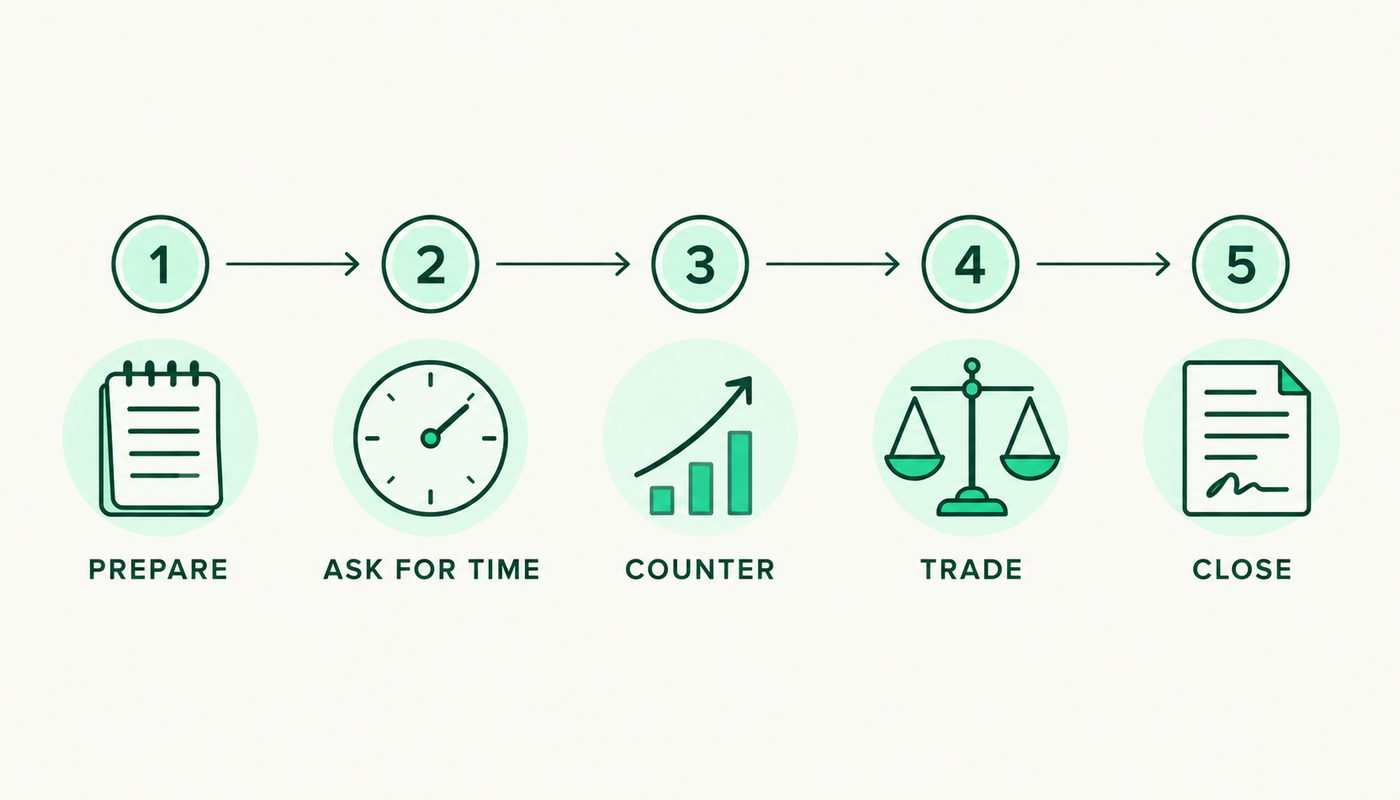
1. Prepare the numbers. Write down your target, your floor and the two or three reasons each is justified. Reasons are specific: a competing offer, a market range from pay-transparency postings, a scope that is bigger than the title suggests, a certification you hold.
2. Buy time, politely. You do not need 48 hours to make a decision. You need enough hours to think and to write a calm reply. One business day is normal. Two is fine if the offer is complex.
3. Deliver one counter, in one message. Malhotra's rule here is important: negotiate multiple items at once, not one at a time. If salary and PTO and start date all matter, raise all three in the same conversation and signal which matters most. Serialising requests makes the other side feel the goal post is moving (UVA Economics).
4. Trade, do not demand. If the hiring manager says the base is capped, ask what else has room. SHRM's note on this is practical: large employers rarely move health and retirement, but hiring bonuses, flexible hours, time off and education assistance are more often on the table (SHRM, Most Employers Open to Negotiating Salary, Not Benefits).
5. Close in writing. When you agree, ask for an updated offer letter with the new terms. The phrase to use is simply, "Could you send a revised letter reflecting what we agreed?"
Scripts that will not make you cringe#
Keep scripts short. Confident is better than clever.
Asking for time, by email.
Thanks so much for the offer, and for the quick turnaround on the written details. I'd like to take a day to review everything carefully, including the benefits summary. Can I come back to you by end of day Thursday with any questions?
One-message counter, by email.
Thanks again for the offer. I'm excited about the role and the team. Based on the market data I've looked at for this title in [city], and the scope we discussed around [specific responsibility], I'd like to ask whether you can move the base to $X. If the base is firm, I'd welcome a conversation about a sign-on bonus or an earlier salary review at six months. Happy to jump on a call to walk through any of this.
Phone response when they ask what number you want.
I've researched the range for this role, and based on my experience and what I bring on [specific skill], I'm looking for something in the $X to $Y range. I'd love to hear where the role is budgeted.
Notice what is not in these scripts. No ultimatums. No comparisons to other candidates. No apologies. One ask, one reason, one invitation to talk.
What is actually negotiable#
Not everything in an offer is equally flexible. This table reflects what SHRM, the Harvard Law School Program on Negotiation and the HBR "15 Rules" piece all converge on, with a nod to how big the employer is.
| Item | Usually negotiable | Why or why not |
|---|---|---|
| Base salary | Yes, within a band | Most companies have a band for the level; you can often move inside it |
| Sign-on bonus | Often | Easier to approve than base, because it does not reset the band |
| Equity or stock | Sometimes | Depends on company stage and whether the grant comes from a pool |
| PTO and leave | Sometimes at smaller firms | Larger employers often standardise this across the group |
| Start date | Almost always | Low cost to the employer |
| Title | Sometimes | Easier to adjust than compensation, but hits internal equity |
| Remote or hybrid days | Varies a lot | Set by team policy more than HR; the hiring manager is the person to ask |
| Health and retirement plans | Rarely | Heavily regulated and standardised across the workforce (SHRM) |
| Relocation support | Often | Already a line item in many budgets |
| Learning or certification budget | Often | Small cost, strong retention value |
A useful mental model: anything that applies uniformly to a large group is hard to change, and anything the hiring manager personally controls is easier.
Red flags that mean stop negotiating#
Negotiation is a conversation, not a chess match. A few signs the conversation is done:
- The recruiter says the band is firm after you ask once. Pushing harder makes you look like someone who cannot read a room. Switch to non-base items.
- The hiring manager goes quiet after a counter. Give them a few days before any follow-up, and when you do follow up, be warm and brief.
- They retract the offer, or threaten to. This happens, and it is a signal about the company, not about you. The Harvard Law School Program on Negotiation notes that pay transparency is slowly shifting the balance here, but exploding and retracted offers still exist (Harvard PON).
- You get your target. Say yes, in writing, the same day. Do not go back for one more thing.
Interview prep helps you negotiate too#
A lot of your leverage is built before the offer, in how you talked about scope, impact and the specific problem the team is trying to solve. If that part of your process could use work, our job interview preparation guide covers the storytelling and the behavioural questions that lead to stronger offers.
Close#
The honest version of this advice: most offers move a little, some move a lot, and a few do not move at all. You will not know which one you have until you ask. Ask once, ask well, back it up with research, and respect a firm no when you hear one.
For the full research-to-counter sequence, read the pillar: How to Research and Negotiate Your Salary: A Complete Guide. If you need to compare an hourly rate against a salaried offer, Onlano's hourly to salary calculator will give you a clean annual figure to negotiate against. And if your next round of offers starts well before the counter, our complete resume guide is the earlier step.
Sources#
- Pew Research Center, When negotiating starting salaries, most U.S. women and men don't ask for higher pay - 2023 survey of 5,775 U.S. adults on who asks for higher pay at hiring and what they get.
- SHRM, Ask HR: Tips for Negotiating Salary - HR-side guidance on how many counters is reasonable and what items to raise beyond base pay.
- SHRM, Most Employers Open to Negotiating Salary, Not Benefits - WorldatWork and Korn Ferry experts on which parts of a package move and which are standardised.
- Harvard Law School Program on Negotiation, Negotiating a Salary When Compensation Is Public - How posted salary ranges change candidate strategy and why to negotiate the whole package.
- University of Virginia Economics, 15 Rules for Negotiating a Job Offer - UVA's reprint of Deepak Malhotra's Harvard Business Review article with 15 negotiation rules.
- Payscale, Shocking Facts About Negotiating Your Salary - Survey of 31,000 workers on who asks for raises, who does not, and why.