Key takeaways#
- Fake job postings have moved from fringe to industrial scale. The Better Business Bureau's 2024 ScamTracker Risk Report ranked employment scams the second riskiest scam type consumers reported, with a median loss of $1,500.
- Remote and "work from home" listings get targeted hardest, because the whole hiring process can run over text and email without a scammer ever having to show their face.
- Most of the damage comes from a short list of patterns: upfront "equipment" fees, fake checks you deposit then wire back, data-harvesting applications, brand impersonation, task-based "earn money liking videos" apps, and reshipping schemes that turn you into a money mule.
- A careful reader can catch almost all of them by checking three things: the domain the email came from, whether the hiring process ever happens on anything other than Telegram or WhatsApp, and whether anyone is asking for money or bank details before you've signed anything.
- If you already replied, close the loop fast: stop talking to the "recruiter," report to the FTC and the FBI's IC3, freeze your credit if you shared sensitive data, and tell your bank if any money moved.
The scale, and why remote jobs sit in the crosshairs#
Job scams have climbed every year that regulators have measured them. The FBI's Internet Crime Complaint Center (IC3) now logs employment fraud as one of the top complaint categories by volume, inside a 2024 report that documents more than $16 billion in total reported cybercrime losses across all crime types. The BBB's own 2024 ScamTracker Risk Report places employment scams at risk rank #2 among all scam types in the U.S., with the typical victim losing $1,500 before realizing something is wrong.
The sharper rise is in a format that barely existed before the pandemic. The FTC's December 2024 Data Spotlight on gamified job scams logged about 20,000 "task scam" reports in the first half of 2024 alone, against roughly 5,000 for all of 2023. In the same stretch, reported losses from job scams topped $220 million, with cryptocurrency now the most common payment rail inside the category.
Remote roles get hit disproportionately for a boring reason. If a job can be fully performed, interviewed for, and onboarded without a face-to-face meeting or a shared ID photo check, a scammer has no mandatory step they can't fake. The same features that make a remote job appealing (any location, flexible hours, fast turnaround) are the ones that let fraud operate end to end over Telegram.
If you're new to the remote market in general, our remote jobs guide covers what a legitimate hiring process looks like.
The six scam patterns to recognize#
Almost every "remote job" scam fits one of six shapes. Knowing the shape is faster than memorizing a thousand red flags.
1. Upfront fee or "equipment" scams. The offer is real-feeling but the first email after acceptance asks you to prepay for training, certification, a laptop, a software license, or a background check. Sometimes the money is small enough that paying it feels harmless. Honest employers never charge candidates to be hired.
2. Fake-check / money-mule scams. You get a check (usually by mail or as an image to deposit by phone) that is supposed to cover first-month pay plus "office supplies." You're told to deposit it, buy equipment from a specific vendor, and wire or Zelle the balance to a "coordinator." The check is counterfeit. Stanford's University IT team describes the exact variant hitting students and warns that the money transferred out is almost never recoverable once the deposit bounces.
3. Data-harvesting "applications." The posting itself is a trawl. You're walked through a fake application that asks for your Social Security or national ID number, a copy of your driver's license, bank routing numbers "for direct deposit," and sometimes a selfie with your ID. There is no job. The data is the product.
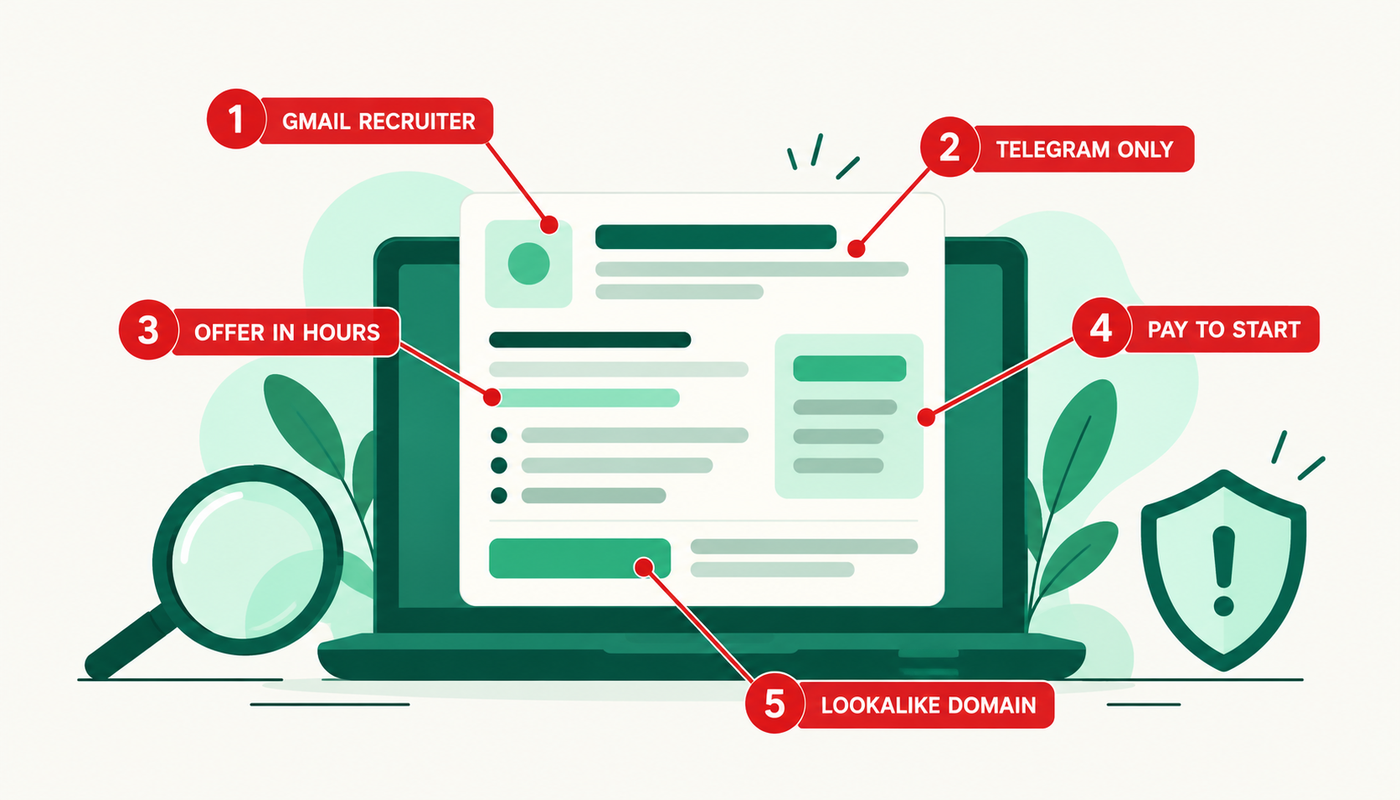
4. Brand impersonation. Scammers lift a company logo and a real recruiter's name from LinkedIn, then message you with an offer that looks like it came from a real employer. The giveaways are the email domain (a Gmail or lookalike like @amaz0n-careers.com instead of @amazon.com) and the fact that nothing can be verified through the real company's own job page.
5. Task-based "earn money from home" platforms. The job is to like videos, rate products, or "boost" listings in an app. You earn fake credits that look like real money. To access bigger tasks or withdraw, you deposit your own money (usually in crypto). The dashboard is theater. The FTC's own position is blunt: being paid to like or rate things online isn't a real job and is often illegal.
6. Reshipping scams. You "work from home" by receiving packages and forwarding them abroad. The packages were bought with stolen credit cards. You get paid nothing and, worst case, end up on the wrong end of a mail-fraud investigation while the stolen goods and your identity move overseas.
The specific red flags a careful reader can catch#
- The recruiter's email is on a free domain (Gmail, Outlook, Proton) while claiming to represent a Fortune 500. Real talent teams send from the company domain.
- The hiring process never leaves Telegram or WhatsApp. No recruiter calendar invite. No official HR portal. No video with camera on.
- Interview "offer" lands within hours of a one-line application, often with no interview at all.
- Grammar is uneven in a way machine translation produces: tense drift, odd capitalization inside sentences, a job title phrased slightly off ("Data Entry Operator Agent").
- Pay is way above market for the title. If a basic data-entry role is advertised at $45 an hour fully remote, something else is going on.
- Any payment flows in your direction before onboarding. A real new hire pays nothing to start. Not even postage.
- The posting lives on a social feed, not a career site. A role on Facebook Marketplace or in a WhatsApp group with no listing on the real employer's own careers page should be assumed fake until proven otherwise.
- ID or bank details are requested before an offer. Social Security numbers, passport scans, and routing numbers belong in onboarding paperwork, after a signed offer, inside a payroll system (Rippling, Gusto, Deel, ADP), never over email.
UC Berkeley's Information Security team summarized the pattern after tracking real losses on campus. In 2023, Berkeley students reported more than $35,000 in employment-scam losses with an average of $2,515 per victim, almost all of it starting from "unsolicited job offers" that moved quickly to a non-university email or a cell number.
Legitimate behavior vs. scam behavior#
| Signal | Legitimate hiring | Scam hiring |
|---|---|---|
| Email domain | @company.com | @gmail.com, @proton.me, lookalike |
| Interview medium | Video (camera on) or phone through HR | Telegram or WhatsApp only |
| Interview questions | About skills, past work, culture fit | About your bank, SSN, home address |
| Timeline | Days to weeks after application | Offer within hours, no interview |
| Payment direction | Employer pays you, after onboarding | You pay employer (training, kit, deposit) |
| Documents collected | After signed offer, in a payroll portal | Before offer, by email attachment |
| Pay vs market | In band for the title and city | Noticeably above market |
| First task | Real work with a manager | Deposit a check, like videos, forward packages |
What to do if you already engaged#
Stop replying first, triage second. The sooner you cut off contact, the less data they can keep extracting.
- Stop talking to the "recruiter." Don't warn them you've figured it out. Just stop.
- Report it. File at reportfraud.ftc.gov and, if any money moved or you shared financial details, also at the FBI's IC3 portal. Reports help regulators pull domains and warn others; they also create a paper trail if you need to dispute a charge.
- Call your bank. If you deposited a check, told the scammer your account number, or sent money by Zelle, Venmo or wire, the bank has playbooks for all of this. They move faster the earlier you call.
- Freeze your credit. If you shared your Social Security number or a government ID, place a free credit freeze with all three bureaus and open a recovery plan at identitytheft.gov. AARP's Fraud Watch Network also walks victims through the follow-up steps in plain language on its fake-jobs page.
- Change passwords. If you reused the password you used on the "application portal" anywhere else, change those first, then everything else.
How a decent job board tries to catch these before you see them#
No board catches everything, but good ones try hard. On Onlano, every employer account is checked against known-fraud domain lists before a posting goes live. We strip postings that ask for payment, that route candidates off the platform into Telegram, or that use a free email address while claiming to represent a brand we can verify. We also publish a job search routine, not just links, so the surrounding context (interview preparation, salary research, writing a resume that doesn't need "upgrading") takes most of the oxygen a scammer needs.
Our full job search routine, including how to tell real postings from theatre, lives in the job search strategy guide. When you're ready to actually apply, start on our jobs page rather than on an open social feed. It won't be perfect; a careful human still has to spot things. But the delta between a vetted board and a random inbox is large, and it's the single easiest change most job seekers can make.
Sources#
- FBI Internet Crime Complaint Center, 2024 Internet Crime Report (PDF) - The FBI's annual accounting of complaints and losses by crime type, including employment fraud.
- BBB 2024 ScamTracker Risk Report (PDF) - The Better Business Bureau's 2024 ranking of scams by consumer risk, with employment scams at #2.
- UC Berkeley: Avoid Costly Student Employment Scams - Campus Information Security advisory with reported losses and the exact tactics used against students.
- Stanford University IT: Job Opportunity Fraud Targeting Students - Stanford's write-up of the fake-check and money-return scam pattern aimed at students.
- AARP: Fake Jobs, Real Losses - AARP Fraud Watch overview of job-scam patterns, red flags and reporting steps.
- ReportFraud.ftc.gov - The Federal Trade Commission's official fraud reporting portal.
- IdentityTheft.gov - FTC-run recovery service with step-by-step plans if your identity data was exposed.