Key takeaways#
- "Tell me about yourself" is almost always the first question, and MIT's career office describes it as a brief introduction of you and your skills, not a walk through your resume.
- The present-past-future format (what you do now, how you got there, why this role) is the one university career centers keep recommending, including UT Austin's Moody College of Communication and Cornell's Career Exploration Center.
- Aim for 60 to 90 seconds. Robert Half frames it as a two-minute window to tell a story that matches the job's must-have responsibilities.
- First impressions move early. In Robert Half Australia's 2022 research, 79% of employers say their initial impression influences their decision, and 63% form it within 15 minutes of an in-person interview.
- Leave out: a complete career history, irrelevant personal background, and any complaint about your current employer.
Why interviewers open with it#
Almost every interview starts with this question. MIT's Career Advising and Professional Development office calls it "almost universally the first question of any interview," and describes it as a chance for you to briefly introduce yourself and your skill set with your target audience in mind.
The interviewer is doing three things at once: warming you up so you talk, forming an early impression of your communication, and seeing which threads you choose to pull. Robert Half's talent manager Tony Koyratty puts it plainly: it is "a fundamentally important interview question disguised as an icebreaker."
That impression lands early. In Robert Half Australia's 2022 research, 63% of hiring managers formed a first impression within the first 15 minutes of an in-person interview, and 56% did so during a virtual one. 79% of employers said that initial impression influences their feedback or decision at least sometimes. That is a reason to put real work into the first 90 seconds of what you say.
The present-past-future format#
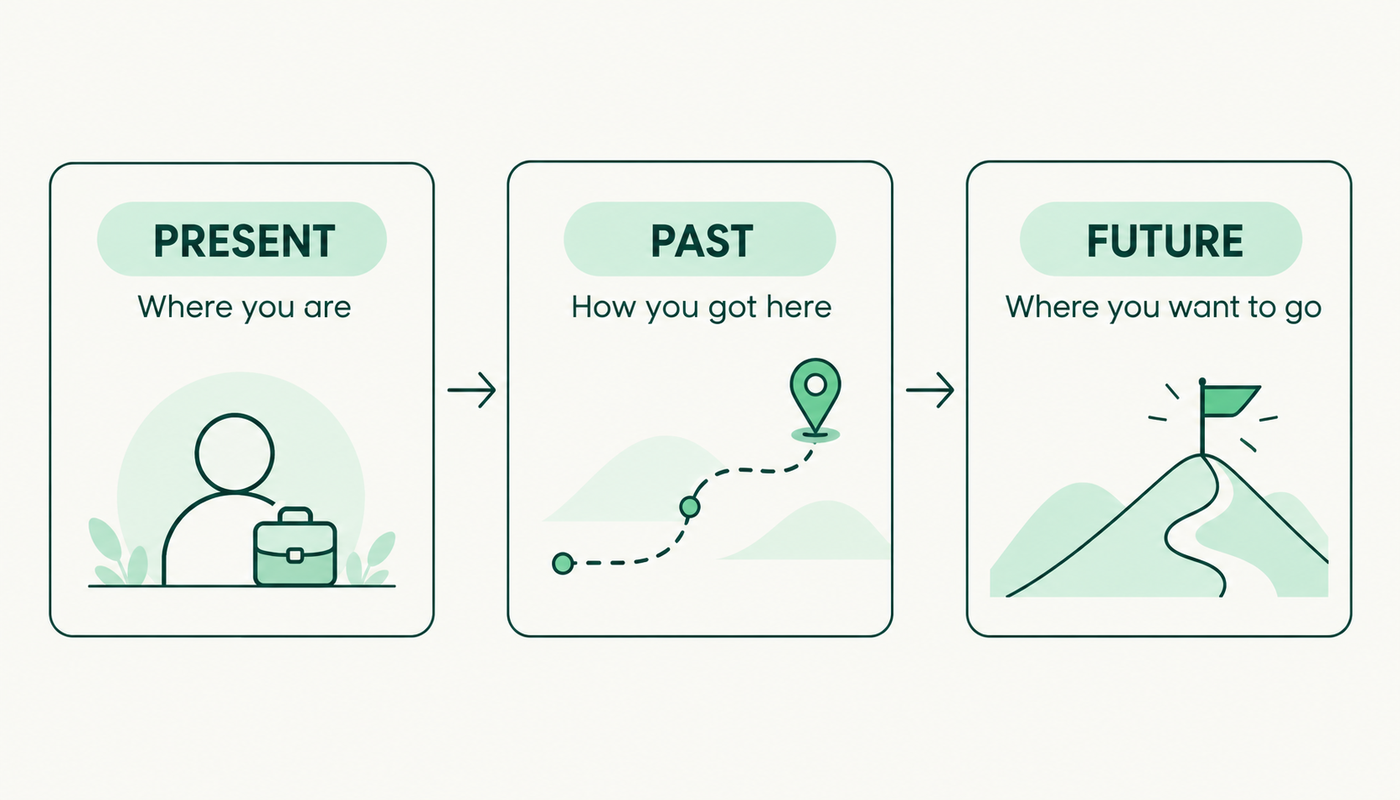
The format that keeps showing up in university career materials is simple. UT Austin's Moody College of Communication describes it this way: start with where you are right now, segue into the past (the experiences and skills that got you here), and finish with the future (why you are excited about this specific opportunity). Cornell's Career Exploration Center credits the same idea to Lily Zhang at MIT, and MIT's own interviewing toolkit uses the same shape: introduce yourself, name relevant skills and projects, close with enthusiasm for the role.
Why this frame and not a full life story? The resume is already in the room. Your job is to tell the interviewer which parts of it matter for this job, in your own voice, before anyone asks a follow-up.
How long is "right"#
About 60 to 90 seconds. Two minutes is the upper bound and only if the content earns it. Robert Half describes the window as two minutes to tell a story that matches the role's must-have responsibilities. If you ran out of fingers counting the companies you mentioned, you went too long. Pick two or three recent, relevant moments and let the follow-up questions do the rest.
What to leave out#
Robert Half calls out three red flags in your answer.
- Getting too personal. Your hometown, family status, and gap-year travel do not belong here unless they tie directly to the work.
- Complaining about your current job. Even once. It reads as a negative attitude and suggests you are running from something rather than toward this role.
- Rehashing your CV in order. Reciting job titles chronologically from your first internship signals a lack of initiative and bores the interviewer.
Cornell's advice adds a fourth: do not over-rehearse. A seasoned hiring manager can hear the difference between a memorized pitch and a well-prepared one. Know your beats, not your sentences.
Common mistakes vs. what to do instead#
| Common mistake | What to do instead |
|---|---|
| Starting with "I was born in..." | Start with your current role and one thing you are known for |
| Reciting the resume top to bottom | Pick two or three moments that match the job description |
| Running past three minutes | Cap it at 60 to 90 seconds and stop |
| Memorizing word for word | Rehearse the beats out loud, not the script |
| Listing every tool you have ever used | Name the two or three skills this job's posting leads with |
| Explaining why you are leaving | Say what you are moving toward |
| Ending without a landing | Close with one sentence on why this specific role |
Four example answers#
Each of these is roughly 150 to 180 words, which is 60 to 90 seconds spoken at a normal pace. They are built as drafts you can rewrite, not scripts to memorize.
1. New graduate applying for a data analyst role#
"I just finished my BSc in statistics at Leeds in June, and I spent the last year of it working as a research assistant in the economics department, cleaning and analyzing panel data for a professor who studies labor markets. That is where I got comfortable in SQL and Python, and where I learned that I like the moment when messy data finally lines up and shows you something you did not expect.
Before that, I interned at a logistics company one summer, writing dashboards in Looker for regional managers, which is honestly what pushed me toward analytics rather than pure research. I liked that someone used what I built the next morning.
I was excited to see this role because it sits between those two things, applied analysis on real business questions, and I would like to do that work on your supply chain team."
2. Mid-career individual contributor, backend engineer#
"I'm a backend engineer, five years in, currently at a fintech called Modulr where I own the payment reconciliation service. Most of what I do day to day is Go, Postgres, and a lot of event-driven work on Kafka. The project I'm proudest of this year was rewriting our settlement engine so it stopped locking the database every Monday morning, which turned out to be worth about four hours of SRE time a week.
I started out in a smaller shop doing Rails monoliths, then moved into payments at Modulr about three years ago when I realized I liked systems that have to be exactly right rather than roughly right.
What drew me to this role is that you are building a payments platform from the ground up, and the job posting mentions idempotency and event sourcing specifically, which is the part of the work I enjoy most. I'd like to go deeper on that here."
3. Career-changer, teacher moving into UX research#
"I taught high school English for six years, most recently in Manchester, and I'm moving into UX research. The link is less of a leap than it sounds. The part of teaching I always liked best was the diagnostic work: watching a class struggle with a passage, figuring out which specific sentence was confusing them, and redesigning the lesson around that. That is pretty much a usability study with teenagers.
Over the last 18 months I finished the Nielsen Norman UX Certification, ran three unmoderated studies as a volunteer for a local nonprofit's donation flow, and shadowed a researcher at a bootcamp friend's company for two projects.
I know I am applying with less commercial research experience than most candidates, and I'm being honest about that. What I bring is six years of practice interviewing people who do not want to be interviewed, which turns out to be the hard part of this work. I'd like to do that at a product company that cares about writing clearly, which is why I applied here."
4. People manager, engineering manager role#
"I manage a team of seven backend engineers at Octopus Energy, and I've been in management for about four years now. Before that I was a senior engineer on the same team, which I mention because it matters for how I run things: I still read code reviews, and I'd rather lose the title than lose that.
The last 18 months at Octopus have been mostly about scaling. The team doubled, we split into two squads, and I had to build the hiring loop, the on-call rota, and the levelling framework roughly in parallel. Attrition on the team is zero over that period and I'm proud of that.
I'm looking at this role because the job description talks about the manager being accountable for the roadmap, not just the people, which maps to how I actually like to work. I'd want to talk about how your platform team is set up and where you see it going in the next year."
Tailoring the same answer to different interviewers#
The same base answer can be slanted for who is in the room.
- HR screen or recruiter. Lead with your current title, the one or two headline skills from the job description, and your motivation for this specific company. Recruiters are matching you against a req, so hand them the match in plain language.
- Hiring manager. Spend more of your 90 seconds on the project or outcome that most resembles what their team does. They want evidence that your past work transfers to their next quarter.
- Panel. Keep it broad enough that each person on the panel hears something that touches their function. Panels fragment attention, so a clear structure matters more than depth.
Where to go next#
The question is a doorway into the rest of the interview, and the rest of the interview is where the offer gets decided. For the full picture of what to prepare, including STAR stories, questions to ask back, and the logistics most candidates get wrong, start with our Job Interview Preparation: The Complete Guide.
To pressure-test what you would actually say under time, Onlano's Assessments include interview-style exercises and skills checks you can run through before the real interview. For related reading, our Resume Writing Guide and Job Search Strategy Guide line up with the same stages of the search.
Rehearse out loud, time yourself, and cut whatever drags past 90 seconds. That is almost the whole trick.
Sources#
- MIT CAPD, Career toolkit: Interviewing - MIT Career Advising and Professional Development's interview toolkit, including guidance on the "tell me about yourself" opener and the STAR method.
- Cornell College of Human Ecology Career Exploration Center, So, Tell Me About Yourself - A Cornell career-center post adapted from MIT's Lily Zhang that lays out the present-past-future formula.
- Robert Half UK, How to answer "tell me about yourself" in an interview - Guidance from Robert Half's senior talent manager Tony Koyratty on the two-minute answer and the three red-flag responses to avoid.
- HR Leader (Robert Half Australia research), A candidate's first impression influences hiring manager's decision making - 2022 Australian research reporting that 79% of employers say their first impression influences their decision and 63% form it within 15 minutes of an in-person interview.
- UT Austin Moody College of Communication, The Most Common Interview Question (PDF) - A one-page career-center handout that walks through the present-past-future formula with a worked example.