Key takeaways#
- WordPress is still everywhere. W3Techs counts it on 39.6% of all websites as of October 2026, so somebody has to build, fix and look after those sites.
- Most WordPress job ads are really one of four jobs: theme work, plugin work, WooCommerce stores, or long-term site care. Know which one you're applying for.
- PHP is the core skill. Modern block development also needs JavaScript and React, and that is where a lot of developers fall behind.
- Remote roles exist, but they're a minority. Read the location line in every ad before you put time into an application.
- A small portfolio of real, live work beats a long list of plugins you've "used".
Why WordPress work hasn't dried up#
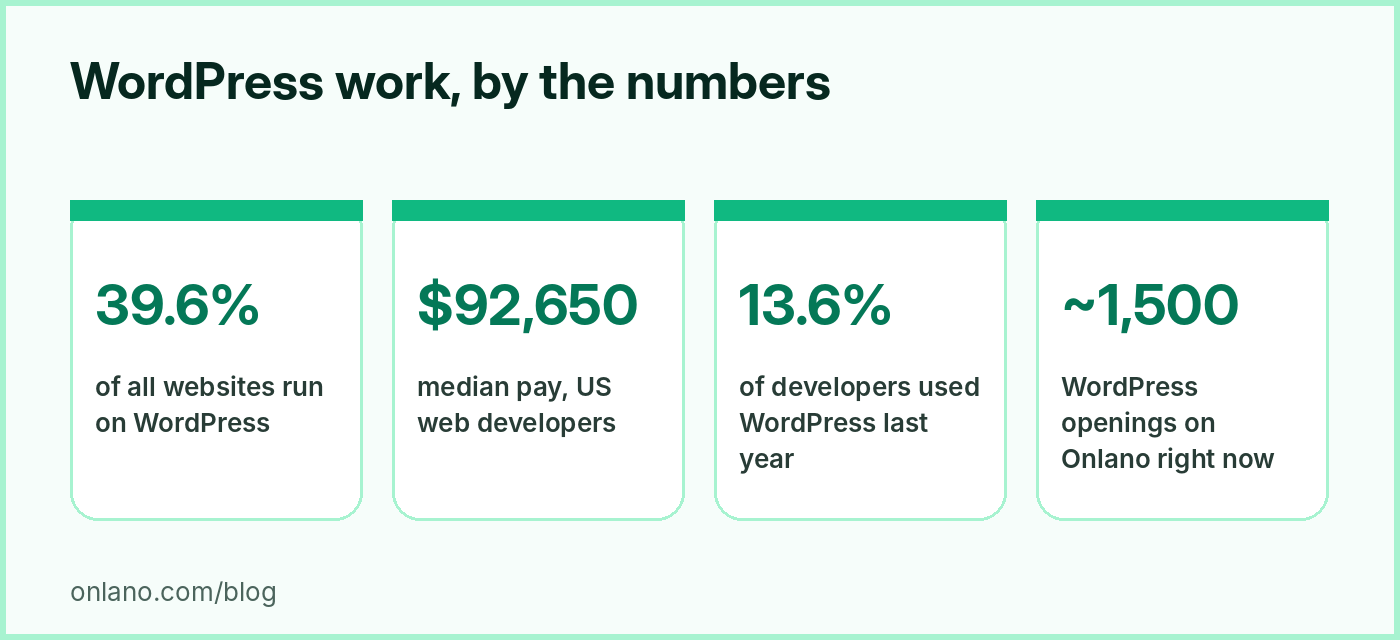
Every few years someone declares WordPress dead. The numbers keep disagreeing. W3Techs, which surveys which software websites run, reports that WordPress is used by 58.3% of the sites whose content management system it can detect, which works out to 39.6% of all websites. Most of those sites are on recent versions too: the same report puts 67.1% of WordPress sites on version 7.
That installed base is the whole story for job seekers. Businesses don't rebuild their website every year. They add a booking form, move to a faster host, fix a plugin conflict after an update, or need a new landing page by Friday. That steady stream of "can you just..." requests is a large part of the WordPress job market, and it doesn't care much about what's fashionable on developer Twitter.
Developers themselves still use it a lot. In the 2025 Stack Overflow Developer Survey, 13.6% of all respondents said they had done extensive development work in WordPress over the past year, ahead of Django and Laravel in the same list.
If you want the wider picture of how WordPress fits next to other tech and design roles, our guide to tech and creative careers covers the whole field. This post stays on WordPress.
The four kinds of WordPress job#
Job titles in this area are messy. "WordPress Developer", "Web Developer", "WordPress Specialist" and "Frontend Developer (WordPress)" can all describe the same work, or completely different work. Reading the duties section tells you more than the title does.
| Type of role | What you'd actually do | Skills that matter most | Who usually hires |
|---|---|---|---|
| Theme and site builds | Turn a design into a working site, build templates and patterns, set up the editor for the client | HTML, CSS, PHP, block themes and theme.json, some JavaScript | Agencies, freelancers' clients, in-house marketing teams |
| Plugin development | Write custom functionality: integrations, custom post types, admin screens, APIs | PHP, WordPress hooks and filters, security basics, testing | Product companies, agencies with bigger clients |
| WooCommerce | Build and maintain online stores, payment and shipping setup, custom checkout logic | WooCommerce internals, PHP, performance, payment gateways | Ecommerce brands, specialist agencies |
| Site care and support | Updates, backups, speed and security work, fixing whatever broke | Debugging, hosting, caching, patience with clients | Agencies, care-plan businesses, larger organisations |
Plenty of jobs mix these. A small agency might want one person who can build a theme on Monday and untangle a WooCommerce tax setting on Tuesday. Larger companies split the work up more.
Skills employers ask for#
PHP, properly#
WordPress is a PHP application (our PHP and Laravel developer career guide goes deeper on the language itself). The official WordPress requirements page recommends PHP 8.3 or newer on the server, and you'll be expected to write PHP that would survive a code review: escaped output, sanitised input, nonces on forms, no direct database queries where a WordPress function exists. The free Plugin Handbook has a security section that covers sanitising, escaping and nonces.
Block themes and the block editor#
This is the part that separates current WordPress developers from people who learned it a decade ago. The WordPress Theme Handbook describes two kinds of themes. Classic themes are built mainly with PHP, JavaScript and CSS and lean on WordPress hooks and filters. Block themes, available since WordPress 5.9, are built mainly from HTML templates and a theme configuration file, and every part of the site is editable as blocks.
Custom blocks are written in JavaScript with React, using the tools documented in the Block Editor Handbook. If the ads you're reading mention Gutenberg, full site editing or custom blocks, this is what they mean.
The rest of the toolkit#
- Git, and the habit of not editing files live on a production server.
- A local development setup, so you can break things safely.
- Basic performance work: caching, image sizes, and knowing why a page builder is slow.
- Enough server knowledge to talk to a hosting company without guessing.
- Clear writing. A lot of WordPress work is explaining to a non-technical client what you changed and why.
What WordPress developers earn#
Pay swings a lot with location, employment type and the kind of WordPress work. Salaried jobs and freelance rates are hard to compare directly, and site care work is often sold as a monthly plan, so convert everything to the same unit before you judge an offer.
For a US reference point, the Bureau of Labor Statistics reports a median annual wage of $92,650 for web developers in May 2025. That figure covers every kind of web developer, so use it as a rough benchmark for WordPress roles. The same source projects employment of web developers and digital designers to grow 5 percent from 2025 to 2035, with about 13,600 openings a year on average.
Outside the US the numbers look very different, and remote roles often pay by the employer's location rather than yours. Before you name a figure, read our salary research and negotiation guide. If a job lists an hourly rate, Onlano's hourly to salary calculator will turn it into a yearly number you can compare.
Finding remote WordPress jobs#
Remote WordPress work is real, but most listings aren't remote. When we looked at WordPress.org's own job board while writing this, it had four open positions and one of them was remote. Its "open to work" list, meanwhile, had 2,711 people on it. That gap is worth keeping in mind: the official board is small, and you'll need to search more widely.
A few things that help:
- Search for the job, not the word "WordPress". Many good roles are titled "Web Developer" or "Frontend Developer" and only mention WordPress in the duties.
- Filter by work mode. On Onlano, the WordPress category had about 1,500 active openings at the time of writing, and each listing shows whether it's remote, hybrid or onsite.
- Check the location rules. "Remote" often means remote within one country or time zone. Our remote jobs guide explains the different versions and how to spot scams, which are common in freelance WordPress work.
- Look at agencies. Agencies that build on WordPress hire steadily and are more open to remote staff than many in-house teams.
Build a portfolio that gets replies#
Hiring managers for WordPress roles look at live sites before they read a resume. Three or four pieces of real work are enough if they're good.
- One site you built from a design. Ideally a block theme. Link the live site and say what you did versus what came from a template.
- One piece of custom code. A small plugin on GitHub is ideal: a custom block, a settings page, an integration with an outside API. Keep the code clean and include a short README.
- One fix story. A slow site you sped up, a broken update you recovered, a security clean-up. Before and after numbers help if you have them.
- A WooCommerce example if you're applying for store work.
Then make your resume match. Our resume writing guide covers the structure; for WordPress roles, list the specific things you built and the tools you used, and link to them.
Checklist before you apply#
- To do: I know which of the four job types this ad is really for
- To do: My portfolio has at least one live site and one piece of custom code
- To do: I've checked the location and time zone rules for "remote"
- To do: My resume names the exact skills from the ad (block themes, WooCommerce, PHP version, and so on)
- To do: I can explain one problem I solved, step by step, in an interview
- To do: I've worked out my rate or salary range before the first call
FAQ#
Do I need a computer science degree to get a WordPress developer job? Most WordPress job ads ask for skills and a portfolio rather than a specific degree. Some larger employers do list a degree, so read each ad, but live work you can show matters more in this part of the market.
Is WordPress development still worth learning in 2026? Given that W3Techs puts WordPress on roughly four in ten websites, there is a lot of existing work to maintain and extend. The developers who do best are the ones who keep up with block development rather than only page builders.
Should I learn React for WordPress? If you want to build custom blocks, yes. The official Block Editor Handbook describes each block in the editor as a React component, so you'll be writing JavaScript and React for that part of the job.
Are freelance WordPress jobs safe to take? Many are, but freelance work attracts scams. Never pay to get a job, be wary of anyone who wants to move you to a chat app before you've seen a real company, and agree on payment terms in writing before you start.
Sources#
- W3Techs: Usage statistics and market share of WordPress
- US Bureau of Labor Statistics: Web Developers and Digital Designers, Occupational Outlook Handbook
- Stack Overflow Developer Survey 2025: Technology
- WordPress.org: Requirements
- WordPress Developer Resources: Theme Handbook
- WordPress Developer Resources: Block Editor Handbook
- WordPress Jobs (official job board)
About the author. Onlano Editorial writes practical guides for job seekers and employers using Onlano. We research each article from public sources, which are linked above, and update it when the facts change.