Key takeaways#
- PHP is not going anywhere soon. W3Techs finds it on 69.2% of websites whose server-side language it can detect.
- PHP jobs split into a few clear types: Laravel product work, agency and CMS work, and keeping older systems alive. The version numbers in an ad tell you which one you're looking at.
- Laravel ships a new major version every year and supports each one with security fixes for two years, so employers expect you to know recent releases.
- Juniors get hired on fundamentals and one solid project. Seniors get hired on judgement: queries, queues, tests and upgrades.
- Pay benchmarks exist, but none are PHP-specific. Compare offers in the same unit and the same market.
Is PHP still a good career bet?#
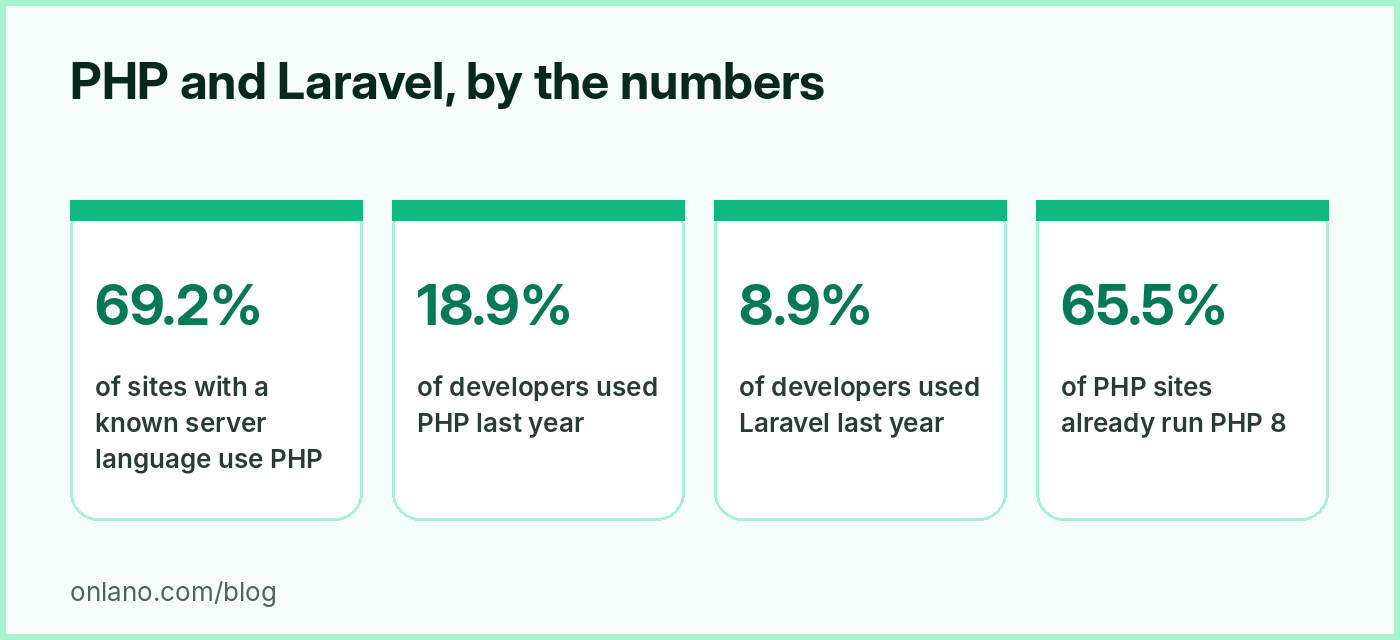
The short answer is yes, as long as you keep up. W3Techs, which tracks the technology behind websites, reports that PHP is used by 69.2% of all sites whose server-side programming language it knows. That is a huge amount of software that needs features, fixes and upgrades.
It's also more modern than its reputation. In the same W3Techs data, 65.5% of PHP sites are on version 8, with 26.8% still on version 7 and 7.7% on version 5. Those older sites are their own source of work, which we'll come back to.
Among developers, the 2025 Stack Overflow Developer Survey found 18.9% of all respondents had done extensive work in PHP in the past year, and 8.9% in Laravel. Neither is the most popular option on those lists, and that's fine. A smaller pool of developers serving a very large installed base is a reasonable place to build a career.
This guide is part of our series on tech and creative careers. If you came here from the WordPress side of PHP, we also have a dedicated post on WordPress developer jobs.
The kinds of PHP jobs out there#
Most PHP listings fall into one of these groups. Reading the stack and the duties tells you which, often before you reach the salary line.
| Job type | What the work looks like | Clues in the ad |
|---|---|---|
| Laravel product development | Building and running a SaaS or internal platform: APIs, queues, admin panels, billing | "Laravel", "Livewire" or "Inertia", "Vue/React", "tests", "CI" |
| Agency and client work | Many smaller projects, fast turnaround, often WordPress or Laravel | "agency", "multiple clients", "WordPress", "deadlines" |
| Ecommerce | Stores, payment and shipping integrations, catalogue imports | "WooCommerce", "payment gateway", "ERP integration" |
| Legacy maintenance and upgrades | Keeping older code running and moving it to supported versions | "PHP 7", "legacy", "migration", "refactor", "custom framework" |
| Backend roles where PHP is one of several languages | Services in PHP alongside Go, Node.js or Python | "microservices", "polyglot", "PHP and Go" |
Legacy work gets a bad name, but there is a lot of it. Every site still on PHP 7 or 5 in the W3Techs numbers above is a future upgrade project. If you like making old code safe and tidy, say so in your applications.
Versions matter more than people think#
Version numbers in a job ad are a quick read on the codebase. The PHP project publishes its support schedule, and at the time of writing it looked like this:
| PHP branch | Released | Active support until | Security fixes until |
|---|---|---|---|
| 8.2 | 8 Dec 2022 | 31 Dec 2024 | 31 Dec 2026 |
| 8.3 | 23 Nov 2023 | 31 Dec 2025 | 31 Dec 2027 |
| 8.4 | 21 Nov 2024 | 31 Dec 2026 | 31 Dec 2028 |
| 8.5 | 20 Nov 2025 | 31 Dec 2027 | 31 Dec 2029 |
Anything older than 8.2 no longer gets security fixes from the PHP project. So an ad that mentions PHP 7 is usually an upgrade job, whether it says so or not. Ask about it in the interview.
Laravel moves on a similar yearly rhythm. Its documentation says major releases come out every year, around the first quarter, and each one gets bug fixes for 18 months and security fixes for 2 years. Laravel 12 was released on February 24, 2025, and Laravel 13 on March 17, 2026, supporting PHP 8.3 to 8.5. Laravel 12 also introduced new starter kits for React, Svelte, Vue and Livewire, which is a good hint about the frontend skills Laravel teams pair with PHP.
What to learn at each level#
Junior#
- Modern PHP basics: types, classes, interfaces, Composer, namespaces.
- One framework in depth. For most people that should be Laravel: routing, controllers, Blade, Eloquent, migrations, validation.
- SQL you can write by hand, plus enough Git to work on a team.
- Writing tests. Laravel's documentation notes that testing with Pest and PHPUnit is supported out of the box, so there's no setup excuse.
Mid-level#
- Database performance. The Laravel docs warn about "N + 1" query problems and show how eager loading avoids them. Expect an interview question on this.
- Queues and background work. The docs describe moving slow tasks, such as processing an uploaded CSV file, into queued jobs so the web request stays fast.
- Authentication, authorisation and API design.
- A frontend partner: Livewire, or Vue or React through Inertia.
Senior#
- Upgrades across PHP and Laravel versions without breaking production.
- Architecture decisions you can defend: when to split a service, when not to, how to keep a large codebase readable.
- Reviewing other people's code and mentoring.
- Owning reliability: logging, monitoring, deployments, incident clean-up.
What PHP and Laravel developers earn#
There isn't a reliable public pay figure for PHP developers specifically, so use broader benchmarks with care. In the US, the Bureau of Labor Statistics reports a median annual wage of $135,980 for software developers and $92,650 for web developers, both for May 2025. A PHP job at a product company may look more like the first group; agency and site work often sits closer to the second.
BLS also projects employment of software developers, QA analysts and testers to grow 10 percent from 2025 to 2035, with about 106,100 openings a year on average.
Rates outside the US differ widely, and remote jobs may pay by the employer's market. Our guide to researching and negotiating salary walks through how to find a fair number for your location before you talk money.
How to get hired#
Build one project properly. A small Laravel app with authentication, a queued job, a few tests and a short README says more than five half-finished tutorials. Deploy it somewhere a reviewer can click.
Show you can work with existing code. Many PHP jobs are about code that already exists. A pull request to an open-source package, or a write-up of an upgrade you did, shows that skill directly.
Match your resume to the ad. List versions and tools explicitly: "Laravel 12, PHP 8.3, Pest, Redis queues". Our resume writing guide covers the rest of the structure.
Prepare for practical interviews. If the process includes a take-home task or a code review, practise explaining your choices out loud: why this query, why this test, what you'd do with more time. Our job interview preparation guide covers the different interview formats and how to practise for them.
Search in the right places. On Onlano, the PHP development category had about 1,500 active openings at the time of writing and the Laravel category about 730. Each listing shows whether it's remote, hybrid or onsite, and applying is free for candidates.
Checklist#
- To do: I know which type of PHP job each ad is (product, agency, ecommerce, legacy)
- To do: I'm comfortable on PHP 8.x and a recent Laravel version
- To do: I have one deployed project with tests and a queued job
- To do: I can explain the N+1 problem and how to fix it
- To do: My resume lists versions and tools, not just "PHP"
- To do: I've checked pay benchmarks for my market before the first call
FAQ#
Should I learn PHP or JavaScript first for backend work? Either works. If the jobs you want are Laravel or WordPress roles, PHP gets you there faster. Many Laravel teams also expect some JavaScript for the frontend, so you'll end up learning both.
Is Laravel the only PHP framework worth learning? No, but it's a sensible default. In the 2025 Stack Overflow survey, 8.9% of all respondents had worked extensively in Laravel. Other frameworks have their own job markets; check which ones appear in ads near you.
Do employers care which PHP version I know? Yes. Versions before 8.2 no longer receive security fixes from the PHP project, so teams on older versions are usually hiring to upgrade. Knowing what changed between versions is a real advantage in those interviews.
Can I get a remote PHP job as a junior? It's possible but harder. Remote teams tend to look for people who can work independently, so a deployed project and clear written communication matter even more. Our remote jobs guide covers how to stand out.
Sources#
- W3Techs: Usage statistics of PHP for websites
- PHP: Supported versions
- Laravel documentation: Release notes and support policy
- Laravel documentation: Testing
- Laravel documentation: Eloquent relationships
- Laravel documentation: Queues
- Stack Overflow Developer Survey 2025: Technology
- US Bureau of Labor Statistics: Software Developers, Quality Assurance Analysts, and Testers
- US Bureau of Labor Statistics: Web Developers and Digital Designers
About the author. Onlano Editorial writes practical guides for job seekers and employers using Onlano. We research each article from public sources, which are linked above, and update it when the facts change.